Seeing Systems, Finding Home

Category: Public Safety (Page 1 of 2)

On Becoming a Wildland Firefighter at 60

Friends who know me as a software and intelligence product manager and executive have asked how I ended up doing wildland firefighting with Spring Valley Fire Department. Believe me, I’ve asked myself the same question. It tends to pop into my head in situations such as hauling a 45-lb. pack up a steep hill in 90 degree weather and the air filled with smoke. I joke that that’s when I question my life choices. (Okay, it’s not entirely a joke.) Here’s how it happened.
Public safety is not new to me. I took a break from college decades ago and worked a few years as a paramedic. When I returned to school, I volunteered with the Salvation Army’s Emergency Disaster Services, which included feeding and caring for firefighters in Pittsburgh and surrounding areas. One of my friends from that group was a volunteer firefighter who was killed in the line of duty. His funeral had a profound effect on me, particularly the words, “Greater love has no one than this, to lay down one’s life for one’s friends” (John 15:13).

Fourteen years ago I found myself at another line-of-duty-death funeral – for our niece’s husband, a U.S. Marine who was killed in action in Fallujah, Iraq. That helped me realize that I was still carrying a heavy “stress backpack” from things that happened long ago. I met Janet Childs, the director of the Bay Area Critical Incident Stress Management Team (CISM), who helped me begin to let go of some of that weight. I accepted her invitation to join the team, received training and began volunteering in crisis intervention.
One of our CISM team members, who became my mentor and spiritual director, was serving as a fire chaplain for a large agency. When he decided to step down, he asked if I would replace him. After a couple of weeks of debating, I said yes. During my chaplain training, I became friends with members of the CAL FIRE Employee Support Services team. I was part of a group of chaplains who responded to the Rocky Fire in Lake County in 2015. The enormous Valley Fire, also in Lake County, started a short time later and CAL FIRE hired me as a contractor for peer support.

After the Valley Fire, I decided I wanted more wildland fire training, for safety’s sake, so I joined the local CAL FIRE Volunteers in Prevention program. Our duties include operating a mobile command vehicle (I have a ham radio license, which is part of skills required), staffing the Copernicus Peak fire lookout tower (the highest point in the Bay Area, a wonderfully relaxing place) and various public relations events.

Meanwhile, satisfying jobs in product management seemed to become much more difficult to find. I’m most at home in smaller companies and turn-around situations. The problem with those is that the company will nearly always either outgrow me or fail. Either way, I was getting laid off every few years. At some point, I decided that I was done with the high-tech industry, at least as a product guy. I am looking at bringing stress management and resilience wisdom from public safety into the private sector. It’s needed.

Ten years ago, I first met Spring Valley Fire Department, which protects about 200,000 acres of wildland east of Milpitas and San Jose. I led a critical incident stress debriefing for firefighters involved in a difficult response to a traffic accident. The debriefing became horribly memorable – I had asked a Santa Clara County firefighter to assist me, but he decided he needed a “mental health day” instead. While we were doing the debriefing, while bicycling, he was struck and killed by racing motorcyclists.
I joined Spring Valley last spring after talking to a couple of the chiefs while I was recruiting for the CAL FIRE VIP program. Since CAL FIRE was hiring me periodically for peer support at big fires, I wanted more training and experience with wildland fire. I didn’t realize that although Spring Valley is primarily a volunteer fire department, our firefighters can work for pay covering CAL FIRE stations when extra help is needed. (This year, a whole lot of help has been needed compared to past years.) I jumped at the opportunity. Meanwhile, I’ve also qualified as a federal firefighter/EMT to be able to work as a fireline EMT for Wilderness Medics, but I’m still waiting for my first assignment.

Along the way, I published the Pocket Guide to Stress Management and Crisis Intervention, which is now used by hundreds of public safety agencies, became an instructor for CISM, CPR and related topics, and I’m working on a book titled “The Resilience Recipe.” I’m thinking the subtitle might be “Your Brain Will Do That,” because it is mostly about how our brains respond to stress and trauma, and what they need in order to bounce back (spoiler – we need physical, social and spiritual connections).

Those are the events that led me here. At the risk of boasting, I’ll say that it’s been difficult, physically and mentally. Wildland firefighting is extremely demanding – we have to be able to do hard work in extreme conditions. At 61, it was no easy task to get in shape to be any good at all (and I won’t pretend that I’m anything more than adequate). To qualify for federal incidents, I had to pass the “Arduous Work Capacity Test” – hike (no running) three miles in 45 minutes carrying a 45-lb. pack. Although it’s not that difficult for a young person in good condition, the first few times I tried it, I wondered if I would ever get there.
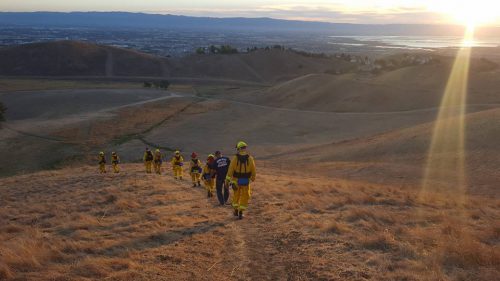
When I look back at the physical training I’ve maintained over the last two years – typically hiking 2-3 miles with a heavy pack at least every other day, weight training at the fitness center every other day – I’m somewhat amazed. Although I was a backpacker and rock climber in my 20s and biked to work for a while, regular exercise was never much more than the thought, “I should do that one of these days.”

To be honest, I was somewhat scared into this self-disciple. A couple of years ago, to my surprise, a routine physical showed that I was pre-diabetic. The exercise has really paid off – my blood sugar is nearly normal and my doctor says I’m the healthiest 61-year-old he has seen. That doesn’t mean I can keep up with the 20- and 30-year-olds I’m working with, but I hold my own. And I keep looking for ways to do better. For motivation, all I have to do is recall hiking up a steep hill with a heavy pack at a fire.

In my writing and teaching, I’m focusing on resilience – our ability to bounce back from adversity. I’ve learned that stress and trauma are enemies of resilience because the “alarm center” in our brains, triggered by stress, will drown out our sources of willpower and motivation unless we do things to quiet it.

Without everything I’ve learned and done about managing stress and unpacking the trauma backpack, I’d never have been able to stick to the discipline that has enabled me to beat back diabetes and become a wildland firefighter/EMT at nearly 62 years old.

Trauma Dogs

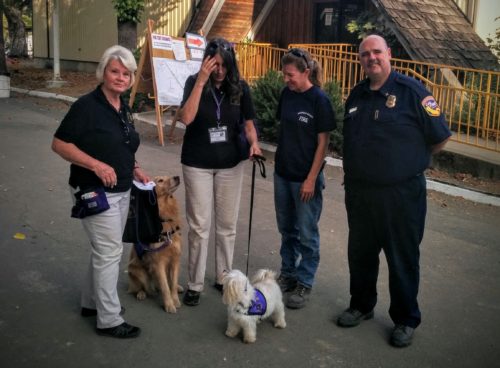
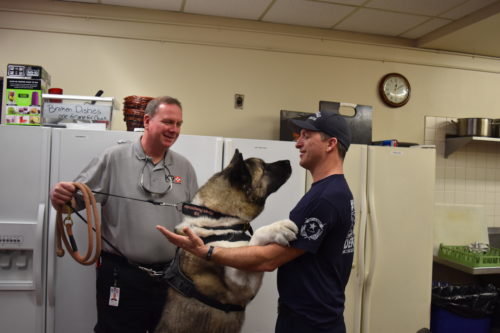
K9 First Responders Brad Cole and Spartacus (showing off) at LV Fire & Rescue.

If you follow me, you know that I’ve been looking at the role of dogs in critical incident and trauma responses. A couple of years ago, while working for CAL FIRE at the big Lake County fires, I noticed, as did the rest of the peer support team, that dogs are excellent

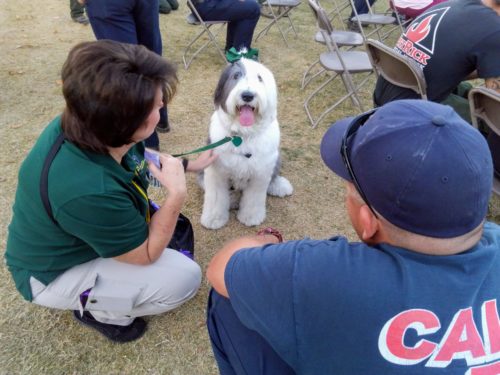
icebreakers. The fact is that few firefighters will stop and talk to peer support ordinarily – but that changes when dogs are involved. Nobody judges when you play with a dog.


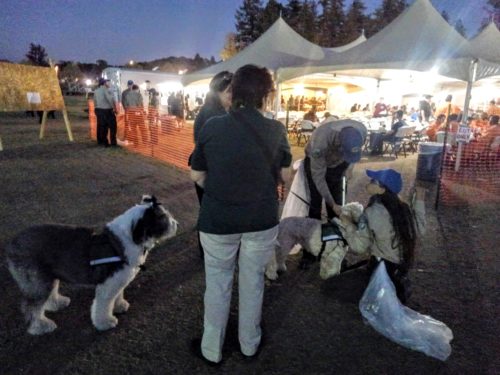
As I wrote last month, we invited many dog teams (a team is a dog and handler) to Santa Rosa during the North Bay fires in October. They certainly proved their worth. We could see people relax and open up while petting or playing with the K9s. A couple of weeks ago, one of the line supervisors, Bill B., told me how he had been doing paperwork in camp, exhausted and cranky, when he saw a dog team approaching. Go away, he thought. I’m too busy. But the team – Michael Jacobs and Molly from Hope AACR – came over to him.

Sharon Martin and Abby from Hope AACR

A minute or later, Bill said, he was relaxed and grateful that they stopped by. That’s the kind of story we want to hear!

Last Thursday, I spent the day visiting Las Vegas Fire and Rescue stations with Brad Cole, the founder of Connecticut-based K9 First Responders (KFR), and his trauma dog, Spartacus. Brad and Spartacus, along with other KFR teams, were deployed to the October 1st mass shootings. KFR has also responded to Newtown for the Sandy Hook shootings and many other crises.

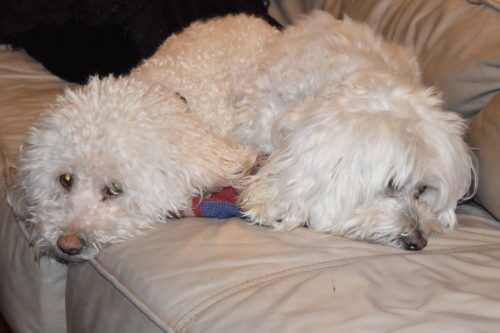
We can learn a lot from dogs about crisis response. They are quite sensitive to our emotions. Recent research demonstrates how well they can read us. Many dogs instinctively go to a person in distress – Brad, others and I have seen this happen many times. It happens in my home, too – when I get frustrated, usually by a computer – Kairo, our Maltese, often comes running to me.

Our dogs, Kasha (Bichon) and Kairo (a very big Maltese)

In other words, the first thing we teach in crisis intervention – to acknowledge emotions – comes naturally to dogs. Equally important, they don’t do things many of us, especially in public safety, have a hard time resisting – they don’t give advice, try to “fix” the person or make it better. They are simply present. The fact that they can’t do anything makes dogs non-threatening; safe to be with.

Dogs don’t understand what happened, but they don’t need to. They just know when we are hurting. They show us that it isn’t necessary to understand what happened. Perhaps responders can tell family and friends that the best way to support them is to act like a dog – just be present.

PALS (Paws As Loving Support) dogs at the Valley Fire, Lake County 2015.

The helpfulness of animals for emotionally distressed people is being researched – primarily horses and dogs, but also dolphins and even cats, despite their aloofness. Eye contact and touch play big roles in helping our nervous systems calm down. Dogs and horses are sensitive to danger, so when they are calm, we know we are safe.

A 2015 literature review of research on animal-assisted intervention concluded that although research is still in early stages, “All reported positive outcomes” for traumatized people. Studies showed reduced depression and reduced PTSD symptoms.

Here in the San Francisco Bay Area, after seeing how effective dogs are, we are increasing our collaboration and integration of K9 teams in crisis response.


15 Days (with dogs) on the North Bay fires

I’m still decompressing from the North Bay fires, but here are some thoughts on the experience.

  • I’m grateful for CAL FIRE’s trust. It is a privilege to work with its Employee Support Services team and CISM leads. They are devoted, compassionate, hard-working people, without exception.
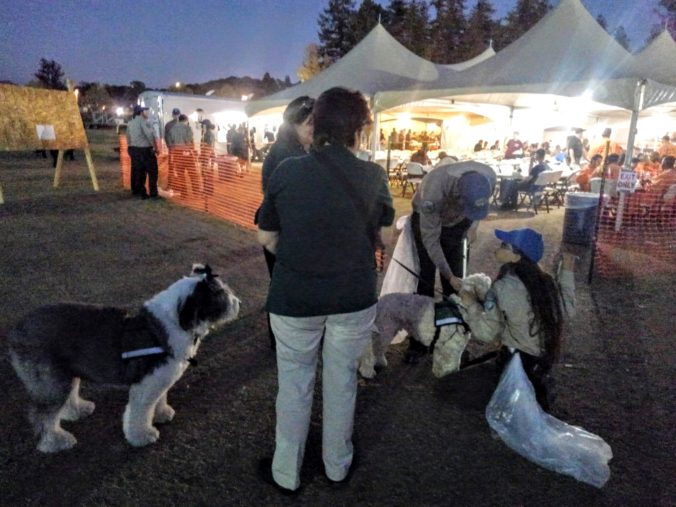
  • If there was a big story coming out of our deployment, it was the dogs. Two years ago, chaplains brought their personal PTSD service dogs to the Rocky and Valley fires (also in the North Bay). We saw what a great comfort and ice-breaker they can be. So this time, we invited just about every trained service, therapy or comfort dog we knew about. The result
    Hope AACR dogs outside breakfast in fire camp.

    Hope AACR dogs outside breakfast in fire camp.

    was that we had dogs present in base camp (which peaked at about 6,000 people) every day. We even took the most highly trained dogs, from Hope AACR, whose handlers were former first responders, out to public safety agencies and neighborhoods that burned. We also had a great response from PALS and others whose names I don’t have. The dogs helped people relax and sometimes seemed to be the key to lowering anxiety about telling their painful stories. As a result, all of us are thinking about how to integrate dogs – and their handlers, of course – into our responses (large or small).

  • Hearing “thank you” from people who lost their homes and entire neighborhoods, was often difficult. For a few days, a crowd of up to 200 people with signs and
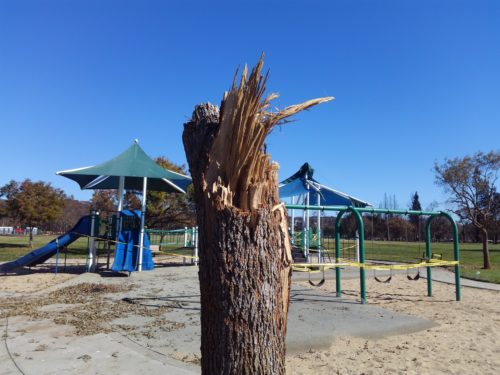
    Tree snapped off in Coffey Park.

    Coffey Park – tree snapped off.

    noisemakers stood on the corner by the fire camp at the county fairgrounds, cheering and waving at every fire vehicle that came or left. It was so overwhelming sometimes that I could not even look at them. I think the gratitude is hard because people in public safety tend to be perfectionists – it makes us good at the work – so we focus on what we did not accomplish.  I found myself repeatedly urging firefighters, EMTs and others to “let it be both” – sadness at the tremendous losses, but pride in what was accomplished. My most difficult thank-you came from a little girl in Coffey Park, perhaps six years old. I gave her a CAL FIRE badge sticker and she looked me in the eye, saying, “Thank you for saving our houses and lives.” I had to turn around, take about 15 steps breathing deeply, before I could turn back, smile and say, “You’re welcome.” I really just wanted to go somewhere and cry. They deserve our tears.

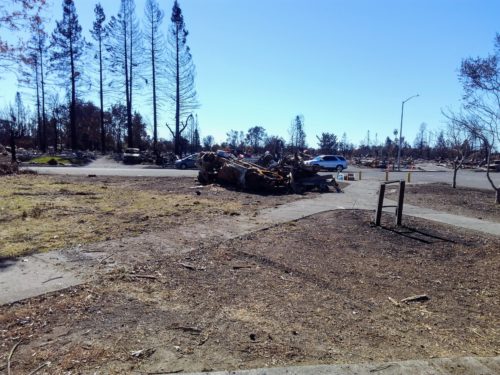
    Coffey Park – note aluminum from a structure caught high in tree.

  • I communicated back and forth with Angela Leath, who heads peer support for the Las Vegas Fire Department. She is dealing with the aftermath of their horrendous shooting incident, so we traded ideas – what’s working, what’s not – about responding to a large incident. Our conversation helped me remember that we can expect many people too struggle with feelings of guilt – that they didn’t do enough, that they made wrong decisions, that they were not there. We know we can’t save every house and every life, but part of us – a good part – will always whisper that we should have.
  • Exercise really helps, even when you are worn out. Eight or nine days into our deployment, I decided that the best thing I could do for myself would be the kind of hiking I ordinarily do every two or three days – three miles, with at least 25 lbs in my pack, at a fast pace (this keeps me in shape for firefighting and has done wonders for my health). Afterwards, I felt almost normal again. It was as if I’d punched a “reset” button in my body and brain.
  • It was an incredible privilege to help distribute cash gift cards from the California Professional Firefighters’ foundation. We could give them to anyone who lost at least 25 percent of their home. Although a  few people accepted them matter-of-factly, most seemed stunned when I explained what was in the envelope. Many big hugs resulted. Thousands of them have been given to fire victims in the North Bay.
  • It seemed as though nearly everybody wanted to tell us their stories. That’s unprecedented, in my experience. Almost everybody – firefighters on the line, doing damage inspection, mopping up, in overhead management – stopped for a while to talk about how they were doing (especially when we had dogs!). That speaks both to the magnitude of the fires and the changing public safety culture. It is becoming okay to acknowledge how difficult this work can be.
  • After doing and teaching this kind of work – crisis intervention and peer support – for more than a dozen years, I usually have some kind and gentle words for any situation. But three times in Coffey Park, I met firefighters who lost their own or family homes. For them, I had no words, just a lot of eye contact and big hugs. And that’s okay – if there is any time no words are needed, that’s it.
  • We will be talking about, and healing from these fires for a long time. Until last month, the “career fire” for most people was the Valley fire in 2015. More than once, our team and others mentioned that we are still dealing with it. This year’s fires killed many more people and destroyed more than three times as many homes. And more than once, I heard someone ask the rhetorical – and scary – question, “Is this the new normal?”
  • Something to be grateful for – because the fire happened at night, when people are home, most of their pets survived. That’s really good.

Peer support act is dead (for now) in California Senate

AB 1116, which would have created privilege (legal confidentiality) for CISM and peer support, is dead for this session of the California legislature. However, it is expected to come back in the 2018 session.

Although the bill passed the Assembly and several Senate committees, no agreement had been reached on how to define the training standards required for CISM or peer support team members to be protected. The current version specifies that the state Office of Emergency Services (OES) would create a new class – and nobody in state emergency services (apparently including OES) thought that was a good idea. But there was not enough time in this legislative session to work out the definition, so the bill went to the inactive file.

Hopefully the relevant state agencies (corrections, CHP, CAL FIRE, OES) will work out a training requirements strategy before the bill comes around again, so that it can pass next year.

Passed CA Assembly – Peer Support and Crisis Referral Services Act

California Assembly Bill 1116, formerly called the Critical incident Stress Management Services Act, has passed the state assembly and is on its way to the Senate. If it becomes law, the act would protect the confidentiality of public safety peer support team interactions except in the case of criminal proceedings. To be covered, team members would have to have completed a peer support training course to be developed by the Office of Emergency Services, the California Firefighter Joint Apprenticeship Committee or the Commission on Correctional Peace Officer Standards and Training.

This legislation would not give the level of protection that a therapist or ordained clergy has, but it will raise the bar considerably – unlike states that have passed similar laws, peer support and CISM teams in California currently have no protection against being subpoenaed. However, in the context of non-criminal proceedings, the legal “privilege” would be the same as between a psychotherapist and patient. The only exception would be “gross negligence or intentional misconduct.”

All of the components of a CISM program along with grief support and substance abuse are named as topics the law would cover.

The bill includes the phrase “toxic stress,” which I believe we should strike from our vocabulary. Stress can be toxic, but it doesn’t have to be, and the phrase “toxic stress” carries a strong connotation that all stress is toxic. That can be a self-fulfilling expectation – if you think stress is toxic, it probably will be.

This is a great step forward for California. I would have preferred that the state also recognize ICISF-approved training, rather than only requiring new courses, but “peer support” covers more than ICISF encompasses, so it is understandable.

If you’re in California, urge your senator to vote in favor. Let’s get the law in place, develop the classes and take the training.

CISM Protection Bill Introduced in California

California may join Michigan and other states that have made CISM activities “privileged” communications, meaning they could not be subpoenaed or otherwise demanded by a court. Michigan’s legislature unanimously passed the “First Responder Privileged Communications Act” a year ago.Subpoena protection for California CISM

California will consider AB 1116, the Critical Incident Stress Management Services Act.

Here is the key provision.

Except as otherwise provided in this section, a communication made by an emergency service provider to a CISM team member while the emergency service provider receives CISM services is confidential and shall not be disclosed in a civil, criminal, or administrative proceeding. A record kept by a CISM team member relating to the provision of CISM services to an emergency service provider by the CISM team or a CISM team member is confidential and is not subject to subpoena, discovery, or introduction into evidence in a civil, criminal, or administrative proceeding.

The exceptions are not problematic – they cover referrals, events where most of us are already mandated reporters, imminent threats and waivers.

The bill was introduced last month by Assemblyman Tim Grayson, former mayor of Concord, California, who is also a Concord Police Department “Critical Response Chaplain.” He undoubtedly knows a thing or two about this issue.

In my dozen years in CISM I’ve dealt with this through our team’s policy of never keeping written records and my own lousy memory for what other people say during interventions.

Guest Post: Emotionless

This week I had a hard time deciding what I would write about. This is my 10th article, so I guess I wanted to write something special. I decided to write about police work and the toll it takes on a person’s emotions . This is not based on any science or psychological analysis but my own experience. Remember also that every person is different and other police officers might have had different experiences, but I think they will find similarities with my story.

To start off, I would like to say that when I first started out as a front line officer, I was learning a lot from more experienced officers. I would take from these officers what fit my personality and also what would work in the field when dealing with the public. I found that I was the type of person who would connect better with the public, whether complainants, victims or even suspects. I would be to get to know them better and know where they are coming from.

No, not the place they are coming from but what type of life they had and what brought them to this point…so in other words, empathize with them. Well for me to do this and for them to come and trust me, I would need to let a little bit of myself go also. Otherwise it’s one-way communication and you will never get any good rapport with anyone that way.

Then all of a sudden, the pulling and tugging stopped.

So this was the way I decided that I was going to police. It fit my values of life better and when I think about it, it saved me from a few tight situation. For example, one night I was working on the Reserve and keeping a close eye on a beer garden along with a local reserve officer. Close to midnight as we were driving in the parking lot, we were flagged down. One of the patrons was going nuts and wanted to fight everybody. My partner and I got out of our vehicle, approaching the subject of complaint and were going to arrest him then and there. Then all of a sudden, his buddies started tugging on us and we were being circled. The more we fought to arrest the subject, the more we were getting pulled and pushed away from this guy. Then all of a sudden, the pulling and tugging stopped. Well lo and behold, when I turned around, a bunch of people that I had built a rapport with in the past had formed a line and were keeping the subject of complaint’s buddies away from us.

For me to get a rapport of that kind,  I had to let a little bit of my personal past out to them as well. But what happens when you do this is that you start to connect with people and the people you connect with the most are the ones you deal with almost on a daily basis – which are the one you get to arrest on a regular basis! You start to really sympathize with most of them because you start finding out that they are the way they are today because of what happened to them in the past.

I found out that some of them had parents that were alcoholics or only one parent who was an alcoholic and sometimes would roam the streets at 2-3 o’clock in the morning at 6-7 years of age so they wouldn’t see the dad, or boyfriend beat up on their moms. Or that some of them had been sexually assaulted by a parent, an uncle or even grandparents as young as three years of age. A lot of social problems resulted in young kids growing up with having to deal with traumatic events when they were very young . I think some of them wanted a different life but growing up just didn’t know where to turn to for help.

Those became what I call today my “robot years.”

Some of these people I got to connect at a close level ended up committing suicide, including two hockey players I had coached a few years before. That really took a toll on my mental health, although I didn’t realize it at the time. Dealing with these types of situations after awhile, those became what I call today my “robot years.” I would actually go to certain calls and it would be like I was on automatic. I would not care at all about a break-and-enter with minor value stolen. I would take notes, make believe that I was concerned, and then leave and write my report and on to the next call.

I had built a wall so well that I was forgetting what it was like to live life like a regular human being.

The robot years started to carry on during my days off. I still remember my wife telling me years after how she would look at me and it would seem like I was a person that just didn’t have any emotions left. I wasn’t seeing it that way, but now that I reflect back on it, I really didn’t have any emotions left at all. Everything was on a level. No highs and no lows. Just functioning through life… like a robot. I had built a wall so well that I was forgetting what it was like to live life like a regular human being. I still feel the effects today, although I do have glimpses of feeling emotions of happiness and sadness, but not as much as before I joined law enforcement. I feel like I am empty inside. Nothing left. This was actually mirrored to me by a very good friend of mine who also worked 28 years in policing and just recently retired. He told me those exact words. That he felt like he had no emotions left inside. That he was dead inside.

I think as police officers, especially the ones who try to empathize with people that are struggling through life, we try to keep our emotions so much in check when attending calls that our mind starts to think that it is not good to have any emotions. And when you think about it, police officers do have to hold back emotions frequently. We can not start to break down and cry uncontrollably in front of the public at a serious accident scene where kids are deceased. Or in one of my cases, tell a seven-year-old that his mom would be okay and asking a firefighter to bring the kid up the embankment for me as I was with the paramedic attending the mom. Her face was a grayish pale with purple lips. I had a feeling she was badly bleeding internally and the paramedic confirmed my assumptions. She died soon after. I always felt a lot of guilt, even today for lying to that kid. But I just didn’t want him to see his mom this way.

I just want to enjoy the peacefulness that nature brings. That to me is true happiness.

I could go on and on about these types of calls that other police officers and I attended. We are to hold our emotions in on a daily basis. After awhile, you do not want to let go of all those emotions at home. Why would I burden my wife on the violence I witness during my shift? I don’t even want to remember them today. So why would I give this hell to someone I love? Doesn’t make any sense. Today, I find a lot of peacefulness and happiness just walking in the woods with my dog. Even though my wife tags along with me at times, she knows that sometimes, I just don’t want to talk. I just want to enjoy the peacefulness that nature brings. That to me is true happiness.

Thank you for those taking the time to read my articles. Please share to whomever you feel could benefit from them. I would really appreciate that. Until next week. Stay safe my friends. 🙂

Norm

Pocket Guide to Stress Management and Crisis Intervention

Until now, nobody has offered a pocket guide covering all of the protocols and methods that we use in stress management and crisis intervention.

Good news! Now there is one.

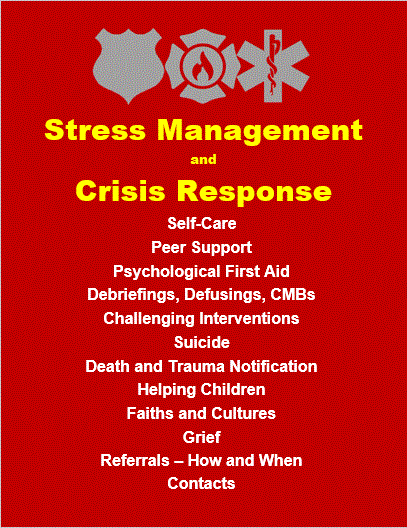
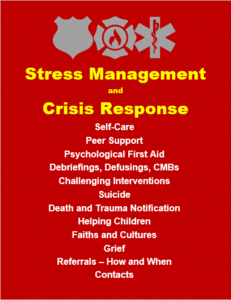
I have written and published a 60-page pocket guide (spiral-bound with durable, Stress Management and Crisis Responsewaterproof covers), including essential references for self-care, peer support, psychological first aid, critical incident stress management (CISM), suicide, death and trauma notification and more. I’ve included sections on helping children and grieving people, and what to keep in mind when dealing with various faiths and cultures – the essentials to review and remember.

In the back of the book, I’ve included a guide on when and how to make referrals, with contact information for national crisis lines and online resources, plus plenty of space for you to write in your own contact and referral information.

For more information, including the Table of Contents, see the Pocket Guides page, where you’ll also find testimonials from the expert reviewers who helped me ensure that this is  a high-quality reference guide.

You can order the guide on Amazon, where you will also find a Kindle version.

Article: How One Paramedic is Recovering from PTSD

The Journal of Emergency Medical Services has published the PTSD recovery story of Benjamin Vernon, a paramedic/firefighter in San Diego. Vernon and his partner who was knifed by a bystander during an ordinary call. He describes the attack, recovery and the nightmares – a word he says isn’t strong enough – that followed. Unfortunately, the therapist he saw had never treated a firefighter or a victim of workplace violence.

“On the fifth day, I finally understood suicide,” Vernon writes.

The story ends well – he finds a competent therapist (whom he’s still seeing weekly) and receives EMDR (Eye Movement Desensitization and Reprocessing), which he describes as “the coolest Voodoo.” (It’s also sometimes called “FM” for “F%&#ing Magic.”)

The danger of “nobody else can understand”

If you are in public safety or the military, as well as some other fields, you know that some people insist that there it is pointless to talk about work to any “outsider.” Often, big agencies have this attitude toward smaller, less busy, ones –  “We are the only REAL firefighters, police, medics, etc., around here.” So they close themselves off from  support by people who otherwise might be peers.

The walls even go up within agencies – specialized, elite teams form a “tribe” mentality that says if you haven’t been part of a similar unit, there’s no point in talking to you about stresses and challenges, even if do the same kind of job.

No doubt, there is some truth to this. Working at a big, busy, urban agency certainly is different from smaller ones. Combat experience absolutely has unique aspects. Being part of an elite or specialized team really is different. People who haven’t walked the walk truly cannot understand. Experience is the only instructor – words quickly fail if we were to try to fully communicate it, especially the emotions around high-stress events (which can directly impact the brain’s speech center).

For a number of years, I have suspected that organizational isolation – that’s this is about – could be as toxic as individual isolation. We know that social support is the most important factor in resilience under stress or recovery from trauma; isolation aggravates stress. In fact, almost any trauma expert will agree that people will continue to suffer as long as they remain isolated –  connections with others give us strength and healing.

I recently began reading Ellen Kirschman’s book, I Love a Fire Fighter: What the Family Needs to Know, which has been sitting on my nightstand for a while. Dr. Kirschman, a well-regarded therapist in public safety, is also regularly involved in the West Coast Post-Trauma Retreat, where I have volunteered and learned.

Here’s the light bulb that went off as I read Kirshman’s introduction – the “nobody else can understand” attitude cuts us off from our friends and family. If you are certain that even a co-worker who isn’t part of your elite unit can’t support you because “they don’t understand,” then how can your friends and family who are civilians, possibly support you?

Here’s one of Kirschman’s observations about going through a fire academy (emphasis mine).

No one acknowledged how the emotional courage fire fighter families need or the independence that is forced on them contributes to the fire service mission. This is extremely puzzling in light of the many studies that confirm how family and friends are the heart of a fire fighter’s emotional support system.

Her books (she wrote a similar one for law enforcement) are for families, but the message to public safety is just as important. Your social support outside of work is also critical to your strength and resilience in the face of occupational stresses, and recovery from critical incidents and other injuries that aren’t physical.

The following words are why it does not matter that outsiders can’t understand the job.

Empathy does not require understanding.

It’s true – if you are an outsider, you will not understand. If you’ve never been there, I can’t explain what it was like to talk to a patient one minute and then do CPR on him, unsuccessfully, the next. You won’t understand how difficult it was to walk past his wife in the ER waiting room, seeing her comforting another wife, not knowing her own husband was just pronounced dead. If you’ve never done anything like helping a family bury their dogs who couldn’t escape a wildfire, nothing I can say will make you understand. If you haven’t been part of a rescue that went all wrong and killed the victim, I don’t have words for the emotions. If you haven’t done shift work, you don’t know the toll it can take.

Even if you cannot understand, that doesn’t have to stop you from supporting a responder if you are a trusted friend – because empathy does not require understanding. They may spare you details. They probably won’t repeat the sick jokes that helps many get through the day. But if you are willing to simply walk beside them, your presence can be healing.

You don’t need to understand responder experiences to know that they are painful. You don’t have to work shifts to that it is hard to be exhausted and miss family events. Everyone has experienced pain and frustration, he stress of an event or life going out of control. Co-workers can appreciate it more than outsiders, so co-workers are an essential part of any responder’s network of social support. So are spouses, friends with completely different careers, pastors and may others.

Camaraderie is powerful. Every agency – and groups within them – benefits from friendships, mutual support and teamwork. However, the idea that only our co-workers or people like them can support us is a misguided obstacle to wellness. We should not want anyone, from new recruits to  seasoned veterans, to believe that their friends and family have little to contribute. As Ellen Kirschman says, that idea cuts t them off from the heart of their social support system.

« Older posts

© 2026 Through the Smoke

Theme by Anders NorenUp ↑