Seeing Systems, Finding Home

Category: Psychological First Aid

15 Days (with dogs) on the North Bay fires

I’m still decompressing from the North Bay fires, but here are some thoughts on the experience.

  • I’m grateful for CAL FIRE’s trust. It is a privilege to work with its Employee Support Services team and CISM leads. They are devoted, compassionate, hard-working people, without exception.
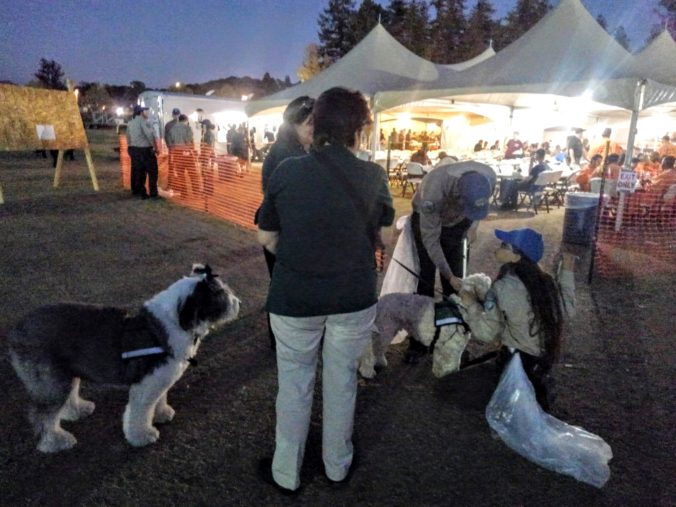
  • If there was a big story coming out of our deployment, it was the dogs. Two years ago, chaplains brought their personal PTSD service dogs to the Rocky and Valley fires (also in the North Bay). We saw what a great comfort and ice-breaker they can be. So this time, we invited just about every trained service, therapy or comfort dog we knew about. The result
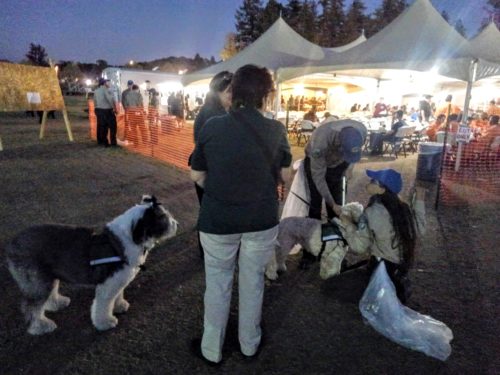
    Hope AACR dogs outside breakfast in fire camp.

    Hope AACR dogs outside breakfast in fire camp.

    was that we had dogs present in base camp (which peaked at about 6,000 people) every day. We even took the most highly trained dogs, from Hope AACR, whose handlers were former first responders, out to public safety agencies and neighborhoods that burned. We also had a great response from PALS and others whose names I don’t have. The dogs helped people relax and sometimes seemed to be the key to lowering anxiety about telling their painful stories. As a result, all of us are thinking about how to integrate dogs – and their handlers, of course – into our responses (large or small).

  • Hearing “thank you” from people who lost their homes and entire neighborhoods, was often difficult. For a few days, a crowd of up to 200 people with signs and
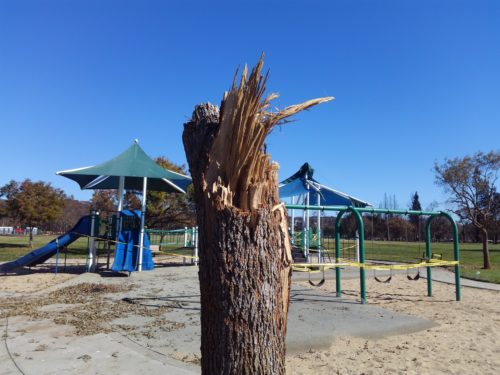
    Tree snapped off in Coffey Park.

    Coffey Park – tree snapped off.

    noisemakers stood on the corner by the fire camp at the county fairgrounds, cheering and waving at every fire vehicle that came or left. It was so overwhelming sometimes that I could not even look at them. I think the gratitude is hard because people in public safety tend to be perfectionists – it makes us good at the work – so we focus on what we did not accomplish.  I found myself repeatedly urging firefighters, EMTs and others to “let it be both” – sadness at the tremendous losses, but pride in what was accomplished. My most difficult thank-you came from a little girl in Coffey Park, perhaps six years old. I gave her a CAL FIRE badge sticker and she looked me in the eye, saying, “Thank you for saving our houses and lives.” I had to turn around, take about 15 steps breathing deeply, before I could turn back, smile and say, “You’re welcome.” I really just wanted to go somewhere and cry. They deserve our tears.
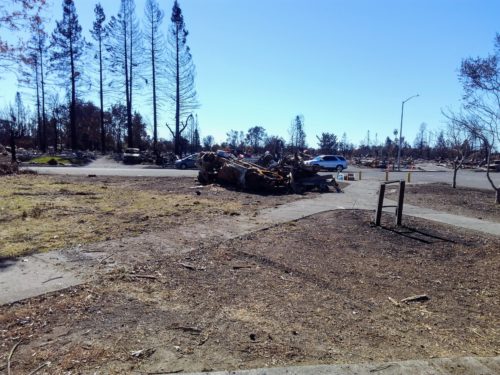
    Coffey Park – note aluminum from a structure caught high in tree.

  • I communicated back and forth with Angela Leath, who heads peer support for the Las Vegas Fire Department. She is dealing with the aftermath of their horrendous shooting incident, so we traded ideas – what’s working, what’s not – about responding to a large incident. Our conversation helped me remember that we can expect many people too struggle with feelings of guilt – that they didn’t do enough, that they made wrong decisions, that they were not there. We know we can’t save every house and every life, but part of us – a good part – will always whisper that we should have.
  • Exercise really helps, even when you are worn out. Eight or nine days into our deployment, I decided that the best thing I could do for myself would be the kind of hiking I ordinarily do every two or three days – three miles, with at least 25 lbs in my pack, at a fast pace (this keeps me in shape for firefighting and has done wonders for my health). Afterwards, I felt almost normal again. It was as if I’d punched a “reset” button in my body and brain.
  • It was an incredible privilege to help distribute cash gift cards from the California Professional Firefighters’ foundation. We could give them to anyone who lost at least 25 percent of their home. Although a  few people accepted them matter-of-factly, most seemed stunned when I explained what was in the envelope. Many big hugs resulted. Thousands of them have been given to fire victims in the North Bay.
  • It seemed as though nearly everybody wanted to tell us their stories. That’s unprecedented, in my experience. Almost everybody – firefighters on the line, doing damage inspection, mopping up, in overhead management – stopped for a while to talk about how they were doing (especially when we had dogs!). That speaks both to the magnitude of the fires and the changing public safety culture. It is becoming okay to acknowledge how difficult this work can be.
  • After doing and teaching this kind of work – crisis intervention and peer support – for more than a dozen years, I usually have some kind and gentle words for any situation. But three times in Coffey Park, I met firefighters who lost their own or family homes. For them, I had no words, just a lot of eye contact and big hugs. And that’s okay – if there is any time no words are needed, that’s it.
  • We will be talking about, and healing from these fires for a long time. Until last month, the “career fire” for most people was the Valley fire in 2015. More than once, our team and others mentioned that we are still dealing with it. This year’s fires killed many more people and destroyed more than three times as many homes. And more than once, I heard someone ask the rhetorical – and scary – question, “Is this the new normal?”
  • Something to be grateful for – because the fire happened at night, when people are home, most of their pets survived. That’s really good.

Pocket Guide to Stress Management and Crisis Intervention

Until now, nobody has offered a pocket guide covering all of the protocols and methods that we use in stress management and crisis intervention.

Good news! Now there is one.

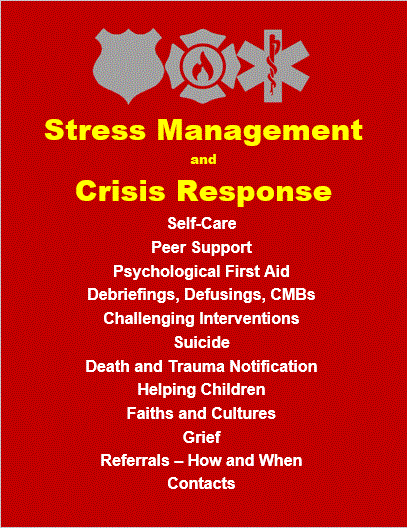
I have written and published a 60-page pocket guide (spiral-bound with durable, Stress Management and Crisis Responsewaterproof covers), including essential references for self-care, peer support, psychological first aid, critical incident stress management (CISM), suicide, death and trauma notification and more. I’ve included sections on helping children and grieving people, and what to keep in mind when dealing with various faiths and cultures – the essentials to review and remember.

In the back of the book, I’ve included a guide on when and how to make referrals, with contact information for national crisis lines and online resources, plus plenty of space for you to write in your own contact and referral information.

For more information, including the Table of Contents, see the Pocket Guides page, where you’ll also find testimonials from the expert reviewers who helped me ensure that this is  a high-quality reference guide.

You can order the guide on Amazon, where you will also find a Kindle version.

Paper: Psychological First Aid: Rapid proliferation and the search for evidence

Psychological First Aid (PFA) – there are many different protocols, great confusion about its relationship to Critical Incident Stress Management (PFA is part of it), and it is increasingly recommended by people and organizations who often don’t seem to recognize that PFA has multiple meanings, is limited in scope and hasn’t yet been confirmed as effective in field evaluations.

I’m not a PFA skeptic – I use it and teach it – but it needs more, careful investigation.

A recent report took a look at PFA’s popularity and lack of field evaluation. The authors are from  two academic centers focused on emergencies and mental health:

The authors give a nod to the down-to-earth nature of PFA guidelines, which are “evidence-informed,” meaning that they are based on related research:

[PFA is] documenting and operationalizing good common sense – those activities that sensible, caring human beings would do for each other anyway.

As the authors observe, the lack of proof that PFA works doesn’t mean it is ineffective. It means that PFA’s effectiveness hasn’t been demonstrated.

They identified forty-eight PFA courses and materials! Yet, oddly, they failed to include one that has been around for quite a while, the SAFER-R model developed by George Everly and incorporated in ICISF CISM training.

Now the bad news.

PFA’s popularity, promotion, and proliferation have not been matched with a commensurate pursuit of evidence demonstrating its effectiveness. Not only is there a dearth of data regarding the benefits of PFA, but there is limited demonstration of widespread commitment to generate such data.

However, like other kinds of crisis intervention, PFA is difficult to study. With nearly 50 different approaches, it is hard for researchers to know exactly what care is being given. There is no way to create control groups – they have to be observed, which is daunting.

The writers offer five recommendations.

  1. Evaluating PFA with first responders, rather than disaster survivors, “may be a good place to start.”
  2. Hospital emergency rooms or other controlled settings might be good places to begin to evaluate PFA for civilians.
  3. We need to figure out how to test its effectiveness for civilians in real disasters. “Predictable disasters” such as annual flooding might create opportunities.
  4. International coordination will make evaluation most effective – agreement on methods and techniques.
  5. PFA should be adapted as the field of trauma evolves. The authors are working on an approach that suggests that early intervention can be tailored to the nature of an incident.

A similar report, by an international group of researchers for the Belgian Red Cross-Flanders, reviewed literature the literature on PFA and came to essentially the same conclusion:

The scientific literature on psychological first aid available to date, does not provide any evidence about the effectiveness of PFA interventions. Currently it is impossible to make evidence-based guidelines about which practices in psychosocial support are most effective to help disaster and trauma victims.

Paper: Psychological First Aid training helps EMS workers

Star of LIfe

A dissertation , Community-based psychological first aid for emergency medical service providers: Mental health stigma, resilience, and social support, published at the University of South Dakota took a look at the effect of Psychological First Aid (PFA) training on EMS workers. Although the study did not confirm the researcher’s hypotheses about why there is stigma in EMS around asking for psychological help, there were two positive findings. Knowledge of PFA gave EMS workers a greater sense that they are supported and a decrease in the self-stigma of getting help.

Results are supportive of PFA as a practical and effective psychosocial support method for EMS providers. The present study contributes to the limited literature on psychological support for EMS providers and invites further research on the topic.


Psychological First Aid and CISM – Clearing the Confusion

(For publication in the California Peer Support Association newsletter.)

Copying this article is permitted: Psychological First Aid – Clearing Confusion (PDF)

The name “psychological first aid” (PFA) has become a source of great confusion and controversy in emergency services. For 60 years, it has been a generic term for offering immediate support to people impacted by highly emotional events. Multiple PFA protocols have been developed, refined and studied for decades.

Confusion about PFA escalated 10 years ago, when the National Child Traumatic Stress Network (NCTSN) published a new PFA protocol, developed with the National Center for PTSD, and touted it as a “replacement” for Critical Incident Stress Management (CISM).

However, PFA has long been a component of CISM, so calling it a replacement is like saying a finger is a replacement for a hand, says Dr. George Everly, a Johns Hopkins psychologist and co-founder of the International Critical Incident Stress Foundation (ICISF), which establishes CISM standards. Everly has pioneered development and evaluation of both CISM and PFA protocols. He was a primary creator of the PFA protocol taught in CISM, the SAFER-R model.

Unfortunately, PFA confusion has led various organizations and agencies to recommend the NCTSN protocol as a “CISM replacement.” For example, a recent U.S. Department of Justice report, Preparing for the Unimaginable, which reviewed Sandy Hook and other mass casualty incidents, recommended NCTSN PFA as a “replacement” for CISM for law enforcement.

Concern over just one CISM component – debriefing – is at the root of the PFA muddle. The debriefing controversy began about 20 years ago when a small number of inconclusive studies of non-CISM debriefing techniques (none of which involved responders) were misinterpreted as suggesting that re-telling a traumatic story during debriefings could cause harm. However, over 35 years, no study has ever showed harm when ICISF protocols are used by trained people. Although much more research into the effectiveness of debriefings and other interventions is needed and welcome, the criticisms of CISM suggesting harm have been discredited.

Get trained, follow the ICISF protocols and rest assured that you are not going to do damage.

PFA’s Confusing Multiple Meanings

The existence of multiple PFA protocols has led to careless misrepresentation of support for the NCTSN protocol. For example, an Everly paper has been misquoted by multiple authors as saying NCTSN PFA is a “best practice” for first responders. However, the paper was actually about the Johns Hopkins RAPID-PFA protocol. (Everly et al., 2006). Reviewers should have noticed that the paper was written before NCTSN PFA was developed! In many other papers, the specific PFA protocol is not identified, casting doubt on whether NCTSN’s was used.

The NCTSN protocol was not developed with responders in mind. “[NCTSN] PFA is basic ‘grassroots’ psychological support provided for family, friends, neighbors and colleagues by members of the general population” (Barbanel and Sternberg, 2005). It was developed for children, schools and communities. The research literature reports that it has been used by faith communities to support their members in disasters, on school campuses, by community mental health, with disaster survivors, Syrian refugees, Greek refugees and domestic violence survivors. Applying it to responders has been an afterthought.

There has been one study of the NCTSN protocol in public safety. In Hong Kong, 900 responders were trained in the protocol in 2012. Early results were positive. (Chan, 2012,)

The NCTSN Protocol is for Individuals, Not Teams

The NCTSN PFA protocol only addresses interventions with individuals. There is no associated group process that would apply to responders, who have a strong sense of group cohesion and typically share trauma as a team. Applying it to a group is a round peg in a square hole.

The NCTSN Protocol’s Effectiveness Remains Unproven

The NCTSN protocol’s creators call it “evidence informed,” which means that it is based on research that identified potential, rather than actual benefits. Multiple expert reviewers say that there is almost no evidence for its effectiveness and further study is needed.

“The scientific literature on psychological first aid available to date, does not provide any evidence about the effectiveness of PFA interventions. Currently it is impossible to make evidence-based guidelines about which practices in psychosocial support are most effective to help disaster and trauma victims” (Dieltjens et al., 2014,).

“Despite popularity and promotion there remains a dearth of evidence for effectiveness and recent independent reviews of PFA have highlighted this important gap” (Shultz and Forbes, 2014).

“More evidenced-based research is still needed to prove the effectiveness of PFA.” (Zhang, Zhou, and Li, 2015).

The Red Cross, which has endorsed NCTSN PFA training for disaster workers, commissioned an independent review, which also found little evidence. “It was determined that adequate scientific evidence for psychological first aid is lacking but widely supported by expert opinion and rational conjecture. No controlled studies were found. There is insufficient evidence supporting a treatment standard or a treatment guideline” (Fox et al., 2012).

CISM is Helpful, not Harmful

The myth that researchers found that CISM is potentially harmful to responders was an odd conclusion of a review of several studies that gave “psychological debriefings” to victims of auto collisions, burns, dog bites and other accidents. In fact, the studies were inconclusive, but even if they actually had demonstrated potential harm, they are irrelevant to CISM and responders.

  • The interventions were inconsistent; ICISF CISM protocols were not followed.
  • No responders were involved – the care receivers were medical patients, victims of burns, accidents, etc.
  • All of the interventions were with individuals, rather than groups.

Another myth is that debriefings (which are just one component of a CISM system) are intended reduce or prevent Post-Traumatic Stress Disorder. Although debriefings may contribute to that goal, they really are intended to help a team “bounce back” from a difficult incident. Their explicit goals are:

  1. Mitigation of the impact of a traumatic event.
  2. Facilitation of the normal recovery processes and a restoration of adaptive functions in psychologically healthy people who are distressed by an unusually disturbing event.
  3. A [debriefing] functions as a screening opportunity to identify group members who might benefit from additional support services or a referral for professional care.

Evidence of many benefits of CISM are documented in the scientific literature. Stress-related symptoms drop, such as depression, anger and anxiety. Alcohol consumption is reduced. Self-esteem and emotional well-being are higher. Recipients are more cooperative with treatment and care. Suicide rates are lower.

None of the scientific evidence could be properly described as making a strong case for CISM, which is undoubtedly one of the reasons for the “controversy” around it. More research is needed.

Isolation is Toxic

Protocols matter, but resistance and resilience to stress – chronic or acute – correlates most strongly to an individual’s social support. Social isolation, like physical isolation, puts people at high risk. So in the end, no matter our approach, demonstrating that we care for each other – that no one has to be alone – is the most important “protocol” of all.

Bibliography

ABPP, Laura Barbanel, EdD, and Robert J. Sternberg PhD. Psychological Interventions in Times of Crisis. Springer Publishing Company, 2005.

Chan, Emily Y. Y. “Preliminary Results of Psychological First Aid Capacity Building Program on Coping Strategies and Mental Health Measures Among Emergency Responders in Disaster: Results of 6-Month Follow-up of a Randomized Controlled Trial.” World Federation of Public Health Associations, 2012. https://wfpha.confex.com/wfpha/2012/webprogram/Paper10006.html.

Dieltjens, Tessa, Inge Moonens, Koen Van Praet, Emmy De Buck, and Philippe Vandekerckhove. “A Systematic Literature Search on Psychological First Aid: Lack of Evidence to Develop Guidelines.” PloS One 9, no. 12 (2014): e114714. doi:10.1371/journal.pone.0114714.

Everly, George S., Suzanne B. Phillips, Dianne Kane, and Daryl Feldman. “Introduction to and Overview of Group Psychological First Aid.” Brief Treatment and Crisis Intervention 6, no. 2 (2006): 130–36. doi:10.1093/brief-treatment/mhj009.

Fox, Jeffrey H., Frederick M. Jr Burkle, Judith Bass, Francesco A. Pia, Jonathan L. Epstein, and David Markenson. “The Effectiveness of Psychological First Aid as a Disaster Intervention Tool: Research Analysis of Peer-Reviewed Literature From 1990-2010.” Disaster Medicine and Public Health Preparedness 6, no. 3 (October 2012): 247–252. doi:10.1001/dmp.2012.39.

Shultz, James M., and David Forbes. “Psychological First Aid.” Disaster Health 2, no. 1 (January 1, 2014): 3–12. doi:10.4161/dish.26006.

Usher, Laura, Stefanie Friedhoff, Sam Victor Cochran, and Anand A. Pandya. Preparing for the Unimaginable: How Chiefs Can Safeguard Officer Mental Health before and after Mass Casualty Events. Washington, DC : Arlington, VA: Office of Community Oriented Policing Services, U.S. Department of Justice ; National Alliance on Mental Illness, 2016.

Zhang, Li, Jiangsong Zhou, and Lingjiang Li. “Crisis Intervention in the Acute Stage after Trauma.” International Journal of Emergency Mental Health and Human Resilience 2015 (January 1, 1970). doi:10.4172/1522-4821.1000299.

Copyright © 2016 Nick Arnett, Stress, Spirit, Science (https://nickarnett.net)

Permission to copy unchanged is authorized.

Psychological First Aid training online

Psychological First Aid (PFA) is a set of crisis intervention techniques that are primarily intended for the public, including skills for children and families.  This training, and quite a bit more, is available on-line from the National Child Traumatic Stress Network.

Although PFA descriptions seem to always mention that it can be used with responders, that’s certainly not the community it was developed for.  The principles apply, but the methods would have to be adapted quite a bit. It does not include any kind of group process, which can be one of the most powerful aspects of Critical Incident Stress Management, which was developed for public safety and other responders.

I’ve had some discussions lately about figuring out a combination of these approaches for CERT (Community Emergency Response Team) members – CISM for their self-care and PFA for offering support to their communities.

© 2026 Through the Smoke

Theme by Anders NorenUp ↑