Seeing Systems, Finding Home

Category: Connecting (Page 2 of 3)

Article: Actually, Let’s Not Be in the Moment

Ruth Whippman takes on mindfulness in the New York Times: Actually, Let’s Not Be in the Moment

Mindfulness is supposed to be a defense against the pressures of modern life, but it’s starting to feel suspiciously like it’s actually adding to them. It’s a special circle of self-improvement hell, striving not just for a Pinterest-worthy home, but a Pinterest-worthy mind.

Mindfulness is a $4 billion market, she reports.

As much as I believe that mindfulness is good, her skepticism is on point. It applies to every relaxation practice – yoga, deep breathing and all the rest. Coping with stress is much more than just learning to relax. As I’ve repeated many times, social support has the strongest correlation to our psychological resiliency. Spirituality – in the sense of having values and bigger-than-self purposes – also matters.

Whippman cites a U.S. Agency for Healthcare Research and Quality report, Meditation Programs for Psychological Stress and Well-Being, which surveyed almost 18,000 journal citations covering 41 trials with about 3,000 participants. Its conclusion was that these practices are helpful, but more study is needed:

Meditation programs, in particular mindfulness programs, reduce multiple negative dimensions of psychological stress. Stronger study designs are needed to determine the effects of meditation programs in improving the positive dimensions of mental health as well as stress-related behavioral outcomes.

Paper: Adolescent stress management – there’s an app for that

Researchers who gave adolescents a mobile phone app for mindfulness and self- compassion, which have been repeatedly shown to help with stress, found that the young people were willing to use the app regularly. Given the ubiquity of mobile devices, this is good news.

Abstract:

The aim of the study was to test the feasibility of a mindfulness and self-compassion based program for adolescents, to be delivered though mobile phones. Twenty racially and ethnically diverse US adolescents enrolled in a study to use the app for 30 days, after which they provided satisfaction data and participated in focus groups to describe their experiences and offer suggestions for improving the app. Usage data were also captured. Results indicated that participants used the app on the majority of days over the intervention period, reported finding it helpful for managing stress, and provided suggestions for substantive areas for improvement. These findings suggest that a mobile app may be a feasible way to disseminate a mindfulness and selfcompassion based program widely among adolescents.

DOI link.

Article: How Transformative Tech Can Bring Out the Best in Us All

Nichol Bradford, CEO of Willow, published an insightful article today on SingularityHub advocating for “inner wellbeing” and the ability of a new generation of sensors and data analysis to bring harder science to the formerly touchy-feely world of studying emotion.

“Too often, the tools for developing mental and emotional wellbeing are mistakenly thought to be solely subjective, shrouded in mystery or religion, or dependent only on luck or human willpower,” she writes.  “This blind spot is dangerous. The lag between our inner well-being and outer abilities results in tremendous social and individual stress. Worldwide you can see people who are overwhelmed by the change.”

Indeed.

Mindfulness Reduces Texting While Driving

I titled an earlier post “We are so desperate to connect with others that we will risk our own lives and those around us to exchange 140 characters while driving.” (which the observant reader will have noticed is 136 characters).

If texting while driving is an indication of hunger for connection, driven by stress-induced mind/body imbalance, then we should expect stress management techniques to reduce the urge to text at inappropriate times. Sure enough, a study of 231 undergraduates at at Simmons College showed that those who scored higher on a mindfulness scale were less inclined to text while driving.

However, to be fair to the researchers, they didn’t see the problem entirely as one of disconnectedness. Their focus was on self-regulation of emotions and attention, which mindfulness has been shown to improve. However, two of the study’s three emotion-regulation questions were clearly relational:

  • “When I am feeling upset, I send or read text messages to distract myself.”
  • “If I am bored or annoyed with the people I am with, I will text someone else.”

Another study, which looked at the social influence on texting while driving among teens and young adults, found that “the more a person believes that their friends and peers approve of and engage in texting while driving, the greater their intention to engage in these behaviours .” Social pressure matters. And so do values, the same study concluded – those who believed it is morally wrong to text while driving are less likely to do so – and the moral influence against texting seemed to be stronger than the social one in favor.


We are so desperate to connect with others that we will risk our own lives and those around us to exchange 140 characters while driving.

Although technology connects us in some ways, it has done much more to disconnect us over the last half-century or so. Freeways, commuting, school busing, television and most recently, handheld devices – all of these have resulted in a society unlike anything in history. Most of us don’t know many of our neighbors, we don’t often see our own families face to face. Most of our co-workers become strangers when the work day is over. Commuter churches are disconnected from their neighborhood.

I’m not a Luddite. Decades ago, when the Web was brand-new, I began to write about how access to more points of view was becoming a positive force in the world. I still believe that, even as Internet

img_20160927_090631

Face-to-face communication is essential sometimes. Photo from the Loma Fire, where I’ve spent most of this week.

gossip also does so much damage. Media domination by a handful of mega-corporations whose mission is to sell eyeballs to advertisers is not good for anyone. Diversity in viewpoints can drive creativity.

Research is uncovering fascinating insights into how our tone of voice, facial expression and eye contact – and even eating together – can act below our awareness to calm our automatic stress responses. Yet those means of communication, which are so important, are almost completely missing from social media. It is no wonder we are desperately eager to stay superficially engaged, even when we know how dangerous distracted driving is.

I myself don’t feel a great need to pay attention to text messages and so forth while driving. Don’t get me wrong – I feel the urge. But I rarely have trouble resisting it. So I’ve asked myself why this might be. The answer from my gut is that I have a good social support network – people I meet with regularly, face-to-face. These are people I trust deeply, from church, work, and our crisis intervention team. Social support has a very strong correlation to resistance and resilience under pressure. My intuition is that for people who build and maintain that kind of support, it is far easier to resist the urge to see and respond to every text, email or posting.

When we don’t have strong social support, we often buy into the myth that just getting away from the sources of stress will give real relief.  However, what really happens is that our “fight-or-flight” response just changes into different kinds of fighting (seen any online political fighting lately?) or fleeing (noticed anybody who is emotionally checked out around you?).

Building Gratefulness

A few years ago, my spiritual director challenged me to list three things I was grateful for, daily, for 30 days. There were a couple of other parts to this exercise, but it was aimed at helping build an “attitude of gratitude.” I’m happy to report that it stuck with me. One of the instructions that helped overcome my perfectionist and self-criticism tendencies was the instruction to not worry about missing a day – just pick it up again. The 30 days didn’t have to be consecutive. gratitude

Psychologists have only recently begun to look into the benefits of cultivating gratitude, but early findings are encouraging, confirming traditional teachings. In two long-term studies of college students and gratitude, researchers in England found that the more often and intensely people feel grateful, the more social support and lowered stress and depression they believe they have. This makes sense because anything that builds social support will almost surely help us cope with stress and do better overall.

Rejoice always, pray continuously, give thanks in all circumstances – 1 Thessalonians 5:16-18.

When we are more grateful, we tend to see the world in a more positive light, which protects against stress and depression. We also make our own world better by thanking helpful people – expressing gratitude – because they become more likely to offer us more support.

Does making gratefulness lists work? Yes, says a recent study titled, “Counting Blessings Versus Burdens.” Across three groups who either kept lists of hassles, things they were grateful for or ways in which they were better off than others, the people who tracked gratitude ended up with a more positive outlook. The gratitude list-makers were also more likely to offer emotional support to others – another example of gratitude encouraging social support. They also spent more time exercising, slept better, had fewer physical complaints and were more optimistic. Daily gratitude tracking was more powerful than weekly.

I will not be afraid, Lord, for you are with me – Psalm 23:4

Another study, on religious involvement and gratitude, showed that attending church more often leads to more gratefulness. The increase was greater for people who believed that God works with them to overcome difficulties and challenges.  This makes perfect sense through the lens of stress as a threat or challenge. When we feel ill-equipped to deal with a situation, our bodies have a “threat” stress response, raising the levels of hormones and neural pathways that cause long-term health problems. On the other hand, if we see the same situation as a challenge – because, in this study, we believe God is with us – our bodies react differently, in a way that doesn’t jeopardize long-term health.

Some other studies on the effects of greater gratitude:

  • Daily well-being increased with daily gratitude practices for Vietnam veterans with PTSD.
  • Gratefulness helps people stick with self-directed interventions to improve their body image.
  • Gratitude in children was related to positive functioning after the 9/11 attacks.
  • People who are more grateful tend to recall more positive life events, which helps make them more positive.
  • Writing about how a good thing, such as finding a romantic partner, might never have happened, increased their positive outlook – to the surprise of the writers.
  • Writing a letter of gratitude, about a time you were at your person best, identifying character strengths all contributed to happiness and positivity, while reducing depression.

Bibliography

Algoe, S. B., & Way, B. M. (2014). Evidence for a role of the oxytocin system, indexed by genetic variation in CD38, in the social bonding effects of expressed gratitude. Social Cognitive and Affective Neuroscience, 9(12), 1855–1861. http://doi.org/10.1093/scan/nst182
Emmons, R. A., & McCullough, M. E. (2003). Counting blessings versus burdens: An experimental investigation of gratitude and subjective well-being in daily life. Journal of Personality and Social Psychology, 84(2), 377–389. http://doi.org/10.1037/0022-3514.84.2.377
Fredrickson, B. L., Tugade, M. M., Waugh, C. E., & Larkin, G. R. (2003). What Good Are Positive Emotions in Crises? A Prospective Study of Resilience and Emotions Following the Terrorist Attacks on the United States on September 11th, 2001. Journal of Personality and Social Psychology, 84(2), 365–376.
Geraghty, A. W. A., Wood, A. M., & Hyland, M. E. (2010). Attrition from self-directed interventions: Investigating the relationship between psychological predictors, intervention content and dropout from a body dissatisfaction intervention. Social Science & Medicine, 71(1), 30–37. http://doi.org/10.1016/j.socscimed.2010.03.007
Gordon, A. K., Musher-Eizenman, D. R., Holub, S. C., & Dalrymple, J. (2004). What are children thankful for? An archival analysis of gratitude before and after the attacks of September 11. Journal of Applied Developmental Psychology, 25(5), 541–553. http://doi.org/10.1016/j.appdev.2004.08.004
Kashdan, T. B., Uswatte, G., & Julian, T. (2006). Gratitude and hedonic and eudaimonic well-being in Vietnam war veterans. Behaviour Research and Therapy, 44(2), 177–199. http://doi.org/10.1016/j.brat.2005.01.005
Koo, M., Algoe, S. B., Wilson, T. D., & Gilbert, D. T. (2008). It’s a Wonderful Life: Mentally Subtracting Positive Events Improves People’s Affective States, Contrary to Their Affective Forecasts. Journal of Personality and Social Psychology, 95(5), 1217–1224. http://doi.org/10.1037/a0013316
Krause, N. (2009). Religious Involvement, Gratitude, and Change in Depressive Symptoms Over Time. The International Journal for the Psychology of Religion, 19(3), 155–172. http://doi.org/10.1080/10508610902880204
Park, N., & Peterson, C. (n.d.). Positive Psychology Progress: Empirical Validation of Interventions Martin EP Seligman & Tracy A. Steen University of Pennsylvania. Retrieved from http://guardianlv.com/wp-content/uploads/2013/09/happiness01.pdf
Watkins, P. C., Grimm, D. L., & Kolts, R. (2004). Counting your blessings: Positive memories among grateful persons. Current Psychology, 23(1), 52–67.
Wood, A. M., Froh, J. J., & Geraghty, A. W. A. (2010). Gratitude and well-being: A review and theoretical integration. Clinical Psychology Review, 30(7), 890–905. http://doi.org/10.1016/j.cpr.2010.03.005
Wood, A. M., Maltby, J., Gillett, R., Linley, P. A., & Joseph, S. (2008). The role of gratitude in the development of social support, stress, and depression: Two longitudinal studies. Journal of Research in Personality, 42(4), 854–871. http://doi.org/10.1016/j.jrp.2007.11.003


Yoga, one of these days!

I recently met Shannon McQuaide, director of Fireflex Yoga, which leads first responder on-duty yoga classes. Meeting her may finally get me to actually try yoga, even though I have believed for a long time that it would be good for me. In fact, I became absolutely convinced of its benefit when I read Bessel van der Kolk’s book, The Body Keeps the Score

Fireflex Yoga

Fireflex Yoga

He devotes an entire chapter, Learning to Inhabit your Body, to yoga and its benefits.

Van der Kolk describes how he heard about Heart Rate Variability (HRV, a big topic of Stress, Science, Spirit) as a measure of how well your brain and body are connected.  Activities that increase your HRV will help quiet the fight-or-flight instinct that is responsible for the negative health consequences of carrying too much stress too long. Remember that, as I wrote in You cannot starve the evil wolf, escaping or avoiding stress usually backfires. You have to “feed the good wolf” through attitudes and activities – anything that increases your HRV will accomplish that. Yoga is a powerful way to “feed the good wolf,” in part because of its emphasis on breathing techniques. HRV essentially measures how well synchronized your heart and breathing are.

Van der Kolk’s research showed that traumatized people, including marines at Camp Lejeune, indicate that yoga is effective for helping people with ordinary or highly traumatic stress heal and grow.

I will admit that I’m a lot like “Annie,” van der Kolk’s patient who said, “I don’t know all of the reasons that yoga terrifies me so much, but I do know that it will be an incredible source of healing for me and that is why I am working on myself to try it.

After the earthquake

After the earthquake

Yoga is about looking inward instead of outward and listening to my body, and a lot of my survival has been geared around never doing those things.” I’m not quite “terrified,” but whenever I think about trying something like yoga, part of me seems to resist, strongly.


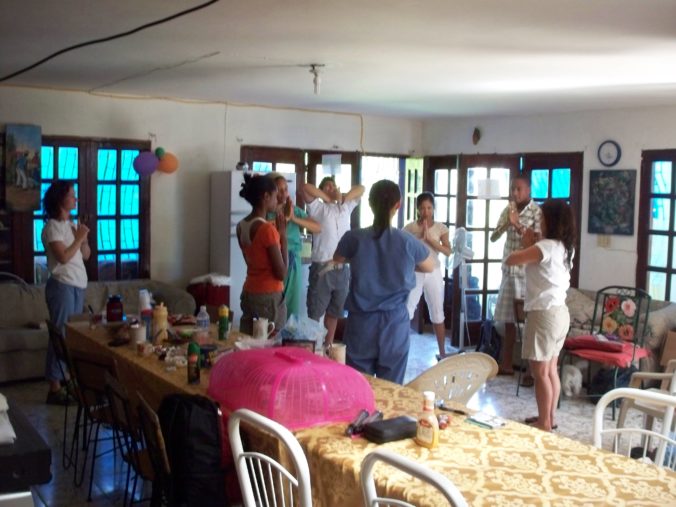
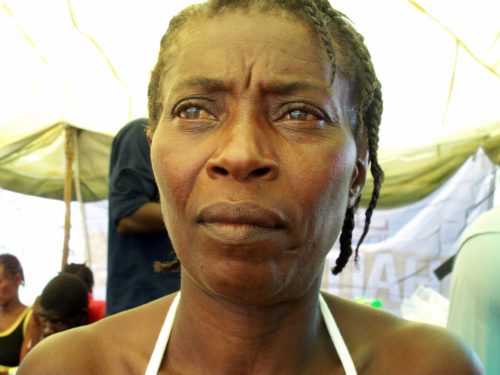
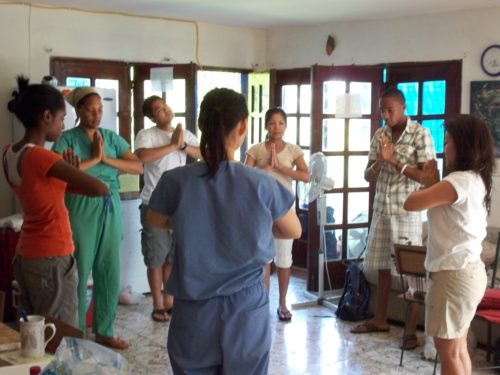
In 1990, I passed up an opportunity to try yoga in post-earthquake Haiti. I was with a Jordan International Aid medical relief team, traveling in and around Port-au-Prince putting on clinics. It was an overwhelming task – every day, far more people were lined up for care than we could possibly see. Women and children were especially hard hit- poor sanitation always hits them harder.

JIA Yoga

JIA medical team doing yoga in Port-au-Prince, Haiti.

Most evenings when we returned to the house where we operated from, some of the medical team would lead a yoga session. Even our Haitian national policemen were joining in, but somehow I just couldn’t bring myself to try it. I can’t claim to know why we sometimes are so resistant to things that we know would be good for us. I do know that it is related to stress and trauma. Shannon has invited me to join one of her classes at a fire station. Somehow, that seems safer than going to a classroom of strangers whose life experiences are unlikely to resemble mine. It seems to be important to start journeys of healing with people who understand, at a level beyond words, where we are coming from.

Oxytocin enhances men’s spirituality

Patty Van Cappellen, a social psychologist at Duke University, took a look at what happens when you give men oxytocin, a hormone associated with social engagement (sometimes mis-labeled the “moral hormone” because it can promote trust, altruism, generosity and intimacy). Men were studied because oxytocin is known to have different effects in men and women.

Two previous studies had suggested that oxytocin – which is released when we connect with others – is connected with spirituality. Oxytocin levels in HIV patients correlated to how spiritual they considered themselves to be. The same correlation was found in a study of devout American Christians.

In Van Cappellen’s study, some men were given oxytocin, others received a placebo. Then they were taught to meditate, a spiritual practice that the researchers believed would help reveal any effect the oxytocin produced.

The men who were given oxytocin were more likely to say afterwards that spirituality was important and that life has meaning and purpose – whether they reported belonging to an organized religion or not. The effects were still present a week later when the men were re-tested.

Oxytocin is just one of several hormones that have been connected to spirituality, but it has many pro-social and other effects that help balance stress. More than any of the others, it has been found to have many psychological effects that are similar to spiritual beliefs and practices – that’s why some were tempted to label it the “moral” hormone.

See the full study here.


Connecting Out

The central teaching in Stress, Spirit, Science is that when we are well connected out, in and up, we can thrive under pressure. Connecting out means social support; connecting in refers to ourselves and creation; connecting up has to do with ethics, values and the divine. Many years ago, I had a powerful connecting out experience when I decided to take a risk by sharing a painful story.

My friend and roommate, Dave Land, and I had started attending Bethel Lutheran Church in Cupertino, in the heart of Silicon Valley. For an upcoming young adult retreat, I had decided to tell about my friend John Heidish Jr., the popular president of the Penn Hills, Pennsylvania, volunteer fire department. He was a fellow volunteer with the Salvation Army Emergency Disaster Services  and was burned to death in a flashover at a house fire just days before his 21st birthday, a year before I moved to California.

I created a “multimedia” presentation, which in those days meant a slide projector triggered by tones in a sound track on a reel-to-reel tape recorder. I used James Taylor’s Fire and Rain as background music. The images were from my fire photos, with “rain” from firehoses.

The Methodist church where John’s memorial took place had pew Bibles and so, with nothing else to do, I picked one up and opened it. I like to read. It opened to John, chapter 13. The first words I read were verse 15, “Greater love has no one than this, to lay down one’s life for one’s friends.” They struck me as terribly, terribly appropriate. At Bethel, I had begun to realize that John’s funeral had affected me deeply. I drove the Sally Wagon (the Salvation Army’s mobile canteen) to the service and arrived early because we knew it was going to be heavily attended – fire companies were traveling long distances, even coming from surrounding states, to pay their respects.

The pastor used John 15:13 as the theme of his message. At the cemetery, he read the verse again as John’s coffin was lowered into the ground.

Those words came back to me in California during Bethel’s young adult group Bible study, when we read Luke 24, the story of grieving disciples on the road to Emmaus, who meet a stranger who turns out to be heidish-plaqueJesus. “Were not our hearts burning within us while he talked with us on the road and opened the Scriptures to us?” echoed how John 13:15 had touched me. I call that my “Emmaus experience,” when I realized that I was no longer just curious to know more about Christianity, but I had come to believe that its stories and teachings are deeply true, offering a path that leads away from death and toward life. At the retreat that day, with my slide projector and tape recorder, this was the story I told my new friends.

When the tape ended, I shut off the projector. The room was completely silent. For a moment I thought that they had all fallen asleep. Then I realized that some were quietly crying. I had experienced my own strong, uncomfortable emotions while creating the story, but I had no idea it might also deeply touch others. More than anything else, I found it intimidating, even scary, to provoke such strong feelings. As a radio and newspaper reporter, I had sought to be provocative, but this was so different – I was “reporting” about myself and receiving tears of empathy. In the safety of that church retreat, I felt new and unexpected connections to my friends.

I shared that story more than 30 years ago and I’m still a member of Bethel Lutheran. Although the people and pastors have changed over the decades, it continues to be a refuge where we lift one another up and share burdens.

In telling my story about John Heidish, I had begun to see how I could revise the past. His story was no longer just a tragic line-of-duty death; my friends and the Bible had given new meaning to his spirit of service, his life and death.

My story about John’s life and death touches the three spiritual themes of Stress, Spirit, Science – metanoia (often poorly translated as “repentance”), redemption and creation. Writing a new story helped me think differently about John’s life and death (metanoia); I discovered spiritual meaning in his sacrifice (redemption); and the retreat itself was a gift of presence and grounding, soil for new growth (creation) as we left behind day-to-day distractions.

How Well Connected are Your Brain and Body?

Adapted from my upcoming book, Stress, Science, Spirit: Connecting Out, Up and In to Thrive Under Pressure.

Ever heard of Heart Rate Variability (HRV)? It measures how well synchronized your breathing and heart rate are – but it is also increasingly recognized as an index for how well you are handling physical and emotional stress.

Every time you exhale, your heart slows down a bit. That’s why breathing techniques for relaxation always instruct you to exhale slowly. The more it slows down, the higher your HRV is likely to be and the better you are coping with stress, numerous studies have found. High HRV is good, in other words.

HRV gives a snapshot into the activation level of your vagus nerve, which is the communications superhighway between your brain and your body.

Research shows that people with high HRV – their hearts speed up and slow down more, synchronized to their breathing – are more resilient, physically and emotionally. Since the vagus nerve influences many of our body’s automatic systems, low HRV is associated with a wide variety of issues – emotional struggles, antisocial behavior, inflammatory and cardiovascular diseases, poor fitness and others. People with low HRV are much more likely to die after a heart attack (Robert E. Kleiger, J.Philip Miller, Thomas Bigger Jr., & Arthur J. Moss, 1987; Thayer, Yamamoto, & Brosschot, 2018).

Although our HRV is determined by genetics and your life experiences, you can change it. Early studies of HRV biofeedback has shown promise for helping to heal a variety of illnesses and injuries:

  • Major depression (Karavidas, et al., 2007),
  • Brain injuries (Lagos, Thompson, & Vaschillo, 2013),
  • Cardiac rehabilitation (Climov, et al., 2014),
  • Addictions – including food (Eddie, C. Kim, Deneke, & Bates, 2014; Meule, Freund, Skirde, Vögele, & Kübler, 2012; Penzlin, et al., 2015),
  • PTSD (Reyes, 2014),
  • High blood pressure (Guiping Lin, 2012),
  • Hostility (Lin, et al., 2015),
  • Chronic pain (Melanie E. Berry, et al., 2014).

HRV biofeedback is also showing promise in life-enhancing uses, including:

  • Improving sports performance by reducing anxiety (Paul & Garg, 2016),
  • Preparing military for combat deployment (Lewis, et al., 2015),
  • Grandmothers raising grandchildren (Zauszniewski, Au, & Musil, 2013),
  • Accelerated learning (Harmelink, 2016).

What do all of these have in common? They are interconnected via your “rest and digest” system (the parasympathetic nervous system). Central to it, the vagus (“wandering”) nerve connects the brain, gut (intestines, stomach), heart, liver, pancreas, gallbladder, kidney, ureter, spleen, lungs, fertility organs (in women), voice, ears and tongue.

High HRV indicates that your brain has greater control over the fight-or-flight system, so you are better able – consciously and unconsciously – to turn it down when danger passes.

Imagine that your body is a fire engine speeding down the road “Code 3” – siren screaming and lights flashing. The fire is out and the emergency is over, but you’re not the driver – you are in a back seat repeating to the driver over the intercom, “Slow down, slow down.” The driver will only ease off the gas and hit the brakes when she can hear your instructions.

“You” are your brain, the driver is your flight-or-flight system, the intercom is your vagus nerve and the speed at which your “slow down” messages are actually reaching the driver is your HRV.

If you are saying “slow down” 20 times a minute, but the driver only hears it five times, that’s low HRV. Your brain isn’t well connected to your body. As a result, neither your conscious mind nor your automatic nervous systems have much control, so the fire truck continues to barrel down the road as if there is still a crisis. In contrast, if most of your messages get through, the driver eases off the gas and the wear and tear on your body is reduced.

The usual goal of “stress management” would be to reduce the stressors, which would be like parking the fire engine – stop responding. Avoid “fires.” But how do you do that if it’s your job?

Instead, you can restore balance through activities and attitudes that help make the “intercom” between your brain and body work better, which will show up as increased HRV. Good news: the vagus nerve is two-way communications, so if you improve your HRV, you will help the back-seat driver’s messages get through.

You can improve your HRV directly through biofeedback, breathing exercises and other relaxation techniques. Even more significantly, your HRV will also reflect the strength of your social support, which is crucial to resistance and resilience to stress. A host of other activities will activate your vagus nerve, which has cascading effects that tell the fire engine (the fight-or-flight instinct) to slow down. Researchers have observed that this happens with yoga, meditation, gratitude, prayer, generosity, trusting and trustworthiness, compassion (for yourself and others), hugging a friend and even having a good cry.  These are the “connecting out (to people), in (to yourself and creation, being grounded) and up (values, ethics, spirituality) that Stress, Spirit, Science will describe in stories and practical advice.

Bibliography

Berry, M., Chapple, I. T., Ginsberg, D., Gleichauf, J., & Nagpal, M. (2014). Non-pharmacological Intervention for Chronic Pain in Veterans: A Pilot Study of Heart Rate Variability Biofeedback. Global Advances in Health and Medicine, 3(2), 28–33. http://doi.org/10.7453/gahmj.2013.075

Climov, D., Lysy, C., Berteau, S., Dutrannois, J., Dereppe, H., Brohet, C., & Melin, J. (2014). Biofeedback on heart rate variability in cardiac rehabilitation: practical feasibility and psycho-physiological effects. Acta Cardiologica, 69(3), 299–307. http://europepmc.org/abstract/med/25029875

Eddie, D., Kim, C., Lehrer, P., Deneke, E., & Bates, M. E. (2014). A Pilot Study of Brief Heart Rate Variability Biofeedback to Reduce Craving in Young Adult Men Receiving Inpatient Treatment for Substance Use Disorders. Applied Psychophysiology and Biofeedback, 39(3–4), 181–192. http://doi.org/10.1007/s10484-014-9251-z

Harmelink, A. (2016). Pilot Study of the Effects of Heart Rate Variability Biofeedback on Perceived Stress, Perceived Coping Ability, and Resilience in Accelerated Baccalaureate Nursing Students. Theses and Dissertations. Retrieved from http://openprairie.sdstate.edu/etd/1015

Karavidas, M. K., Lehrer, P. M., Vaschillo, E., Vaschillo, B., Marin, H., Buyske, S., … Hassett, A. (2007). Preliminary Results of an Open Label Study of Heart Rate Variability Biofeedback for the Treatment of Major Depression. Applied Psychophysiology and Biofeedback, 32(1), 19–30. http://doi.org/10.1007/s10484-006-9029-z

Lagos, L., Thompson, J., & Vaschillo, E. (2013). A Preliminary Study: Heart Rate Variability Biofeedback for Treatment of Postconcussion Syndrome. Biofeedback, 41(3), 136–143. http://doi.org/10.5298/1081-5937-41.3.02

Lewis, G. F., Hourani, L., Tueller, S., Kizakevich, P., Bryant, S., Weimer, B., & Strange, L. (2015). Relaxation training assisted by heart rate variability biofeedback: Implication for a military predeployment stress inoculation protocol. Psychophysiology, 52(9), 1167–1174. http://doi.org/10.1111/psyp.12455

Lin, G., Xiang, Q., Fu, X., Wang, S., Wang, S., Chen, S., … Wang, T. (2012). Heart Rate Variability Biofeedback Decreases Blood Pressure in Prehypertensive Subjects by Improving Autonomic Function and Baroreflex. The Journal of Alternative and Complementary Medicine, 18(2), 143–152. http://doi.org/10.1089/acm.2010.0607

Lin, I.-M., Fan, S.-Y., Lu, H.-C., Lin, T.-H., Chu, C.-S., Kuo, H.-F., … Lu, Y.-H. (2015). Randomized controlled trial of heart rate variability biofeedback in cardiac autonomic and hostility among patients with coronary artery disease. Behaviour Research and Therapy, 70, 38–46. http://doi.org/10.1016/j.brat.2015.05.001

Meule, A., Freund, R., Skirde, A. K., Vögele, C., & Kübler, A. (2012). Heart Rate Variability Biofeedback Reduces Food Cravings in High Food Cravers. Applied Psychophysiology and Biofeedback, 37(4), 241–251. http://doi.org/10.1007/s10484-012-9197-y

Paul, M., & Garg, K. (2012). The Effect of Heart Rate Variability Biofeedback on Performance Psychology of Basketball Players. Applied Psychophysiology and Biofeedback, 37(2), 131–144. http://doi.org/10.1007/s10484-012-9185-2

Penzlin, A. I., Siepmann, T., Illigens, B. M.-W., Weidner, K., & Siepmann, M. (2015). Heart rate variability biofeedback in patients with alcohol dependence: a randomized controlled study. Neuropsychiatric Disease and Treatment, 11, 2619–2627. http://doi.org/10.2147/NDT.S84798

Reyes, F. J. (2014). Implementing Heart Rate Variability Biofeedback Groups for Veterans with Posttraumatic Stress Disorder. Biofeedback, 42(4), 137–142. http://doi.org/10.5298/1081-5937-42.4.02

Zauszniewski, J. A., Au, T.-Y., & Musil, C. M. (2013). Heart Rate Variability Biofeedback in Grandmothers Raising Grandchildren: Effects on Stress, Emotions, and Cognitions. Biofeedback, 41(3), 144–149. http://doi.org/10.5298/1081-5937-41.3.06


« Older posts Newer posts »

© 2026 Through the Smoke

Theme by Anders NorenUp ↑