Seeing Systems, Finding Home

Category: Connecting – Physical (Page 1 of 2)

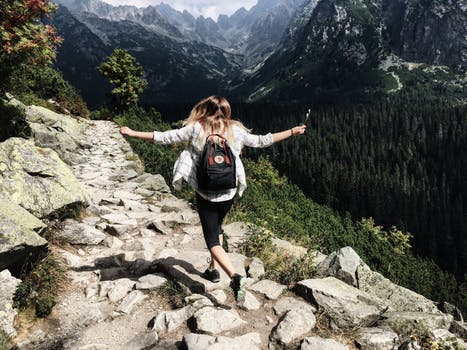
Physical connections – your body and the physical world – help you stay grounded and present. Activities such as exercise, yoga, meditation and hiking help you stay connected down. It is a downward connection because when you look down, you see your body and the earth.

What Hiking Does To The Brain Is Pretty Amazing

Michael W. Pirrone reports on Wimp.com about new studies of the effects of hiking on the brain.

Excerpt: “According to a study published last July in Proceedings of the National Academy of Sciences, a 90-minute walk through a natural environment had a huge positive impact on participants.”

The article reports that hiking in nature lowers brooding and obsessive worry, increases creativity, helps you focus, gives you energy and strong self-image.

Where Are You? Reflections on California Fires

(Message delivered at New Creation Lutheran Church, Sunday, December 17, 2017)

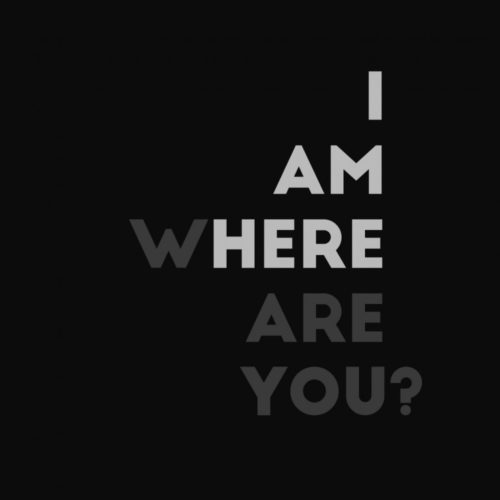
“Where are you?” That’s the first thing God says to a human being in the Bible.

Then the man and his wife heard the sound of the Lord God as he was walking in the garden in the cool of the day, and they hid from the Lord God among the trees of the garden. But the Lord God called to the man, “Where are you?”

He answered, “I heard you in the garden, and I was afraid because I was naked, so I hid.” (Genesis 3:8-10)

Throughout the Bible, God asks people questions, but I think we can be sure it is never because God is hungry for information – God knows the answers. We need to be asked.

We call this story in Genesis the “fall from grace” or “original sin.” We talk about it as our disconnection from God – that’s what the word “sin” means.  But as I have studied faith, psychology and neurophysiology for crisis intervention, peer support and chaplaincy, I have come to see that we need three dimensions of connection. All three become broken in the Genesis story.

The first disconnection is social. Adam, Eve and the serpent, rather than supporting each other, talk each other into doing the wrong thing.

The second is physical. Childbirth and food production will be painful; Adam and Eve will “return to dust,” becoming part of the earth that they were taken from.

The third disconnection is spiritual – they are banished from the garden and no longer have access to the tree with knowledge of good and evil, the tree of life. They no longer walk with God in the garden.

God’s question, “Where are you?” is about relationships. Where are you socially – your relationships, knowing your friends and neighbors? Where are you physically, in relationship with creation, knowing yourself, your body and the earth. Where are you spiritually, in relationship with the divine, knowing what is right and wrong?

I teach this by inviting people to think of them as directions. In wildland firefighting, one of our safety mottos is “Look up, look down, look around” – keep your head on a swivel so you will be aware of all of the things that can hurt or kill you in that dangerous environment.

Look around and you see your social support, which psychologists repeatedly find has the strongest correlation to our resilience under stress and after trauma.

Look down and you see your body and the earth – your physical presence in creation.

Look up and be reminded that the universe is far more than we can comprehend, that as much as we can and should try to dissect and understand it, awe and mystery transcend logic and rationality.

Jesus points to these dimensions when he answers the question “Which is the greatest commandment in the law?” He replies: “Love the Lord your God with all your heart and with all your soul and with all your mind… And the second is like it, ‘Love your neighbor as yourself.” (Matthew 22:36-40). Your neighbor, yourself and God – social, physical, spiritual. How are your connections to them?

Although my primary work with CAL FIRE and others is called “critical incident stress management” or “peer support,” it is really about disconnection and connection.

When God asked Adam “Where are you?” Adam said he was afraid, so he hid. Fear leads us to disconnect from others, the physical world and God.

Fear is powerful. One of the most surprising recent discoveries about stress showed that it is only toxic to your health if you are afraid that it is. A big study about stress over 10 years found that people who had the highest stress level, but did not believe that stress is bad for your health, were least likely to die. (In a wonderful “coincidence,” the church’s theme on the day I offered this message turned out to be 1 John 4:16 – “Perfect love casts out fear.”)
I have never found anything in the Bible that suggests that when life becomes challenging, the answer is be “stress reduction,” which research shows rarely works anyway. The Biblical response to stressful situations is repeated hundreds of times – “Don’t be afraid.” The words that usually follow are, “I am with you.” Relaxation is not the opposite of distress; connection is. Even when Jesus retreated to the wilderness, it was not to disconnect, but to re-connect. Solitude is not the same as isolation.

Whether I respond to a fire as a chaplain or with CAL FIRE’s employee support team, our job is to be present for people to talk to and connect with. Most of it is quite informal, after things really go out of control, we also lead formal crisis interventions. We primarily serve the firefighters, but we have always also been available to other responders and the public. We ask a lot of questions, even though we often know, in a general sense, what the answers will be. In fact, after 15 days on the fires in the North Bay, I felt as though I had heard the same two stories – the citizen story and the responder story – hundreds of times.

For the citizens, it was a story of being woken in the dead of night, wondering if they would escape from a terrifyingly fast-moving fire. The story included many heroes – people who risked their lives to wake up their neighbors and help do things like figure out how to open a garage door when there was no power.

For the responders, the story was about staying awake for more than four days until there was finally enough help that they could take a day off. They talked about embers the size of basketballs blowing a mile or more ahead of the fire; falling asleep holding a nozzle or dozing for a few minutes in their engines only to be woken by someone pounding on their windows and yelling for them to get out because the fire was nearly on top of them. They described situations where it was their job to rescue people they could not reach, and wondering over and over if they would survive themselves.

One thing we never ask is, “How are you doing?” The answer is almost always, “Fine.” To our team, FINE stands for Frustrated, Insecure, Neurotic and Emotional. We don’t let each other get away with that answer, either.

Whether I was talking to citizens or firefighters, all it took for the stories to start pouring out was to say something like, “I know I can’t possibly understand how this is for you, but it’s got to be very hard.”

In this kind of situation, as people talk about what happened to them, we mostly listen, acknowledging and normalizing their reactions. We offer some education and resources to help them get through the crisis. In Santa Rosa, we also had the privilege of handing out $100 gift cards that the firefighters union provided.

Some of the tougher moments came as people talked about their neighborhoods and friendships, realizing that they had not just lost their homes, but entire communities. Along with the physical losses, that is an enormous loss of social connections.

For many of the firefighters, one of the hardest parts was hearing all of the thank-you’s from the community. Like all public safety people, we are perfectionists – the minimum passing score on our job is 100 percent. So it is very difficult to have a person who is sifting through the ashes of their home say “Thank you.” For me, it was most difficult of all when that person was a firefighter. After doing this kind of thing for more than a dozen years, I’m rarely at a loss for words. But for the firefighters who lost their own homes, I had nothing but big hugs. And that’s okay.

For a few days, there was a crowd of a couple of hundred people just outside of the fairgrounds where the base camp was located. They had signs and noisemakers and they would cheer loudly when we drove by, heading out to the fire. I was so overwhelmed that I couldn’t even look at them to thank them or say, “You’re welcome.” More than 8,000 homes were lost in the North Bay. Forty-two people were killed. I had to remind myself, just as I urged other responders, to remember that so many homes and lives were also saved.

In our peer support response, we did something new – we called in every dog team we knew about. At earlier fires, especially in Lake County two years earlier, we’d seen how effective dogs can be.

We saw firefighters, EMTs and dispatchers relax and open up as they petted and played with the dogs. I had a CAL FIRE captain as an instructor a couple of weeks ago. He told me that he was exhausted and irritable, doing paperwork, when one of our dog teams approached him. “Go away, I don’t have time for this,” he thought. Two minutes later, after petting the dog, he said he was relaxed and grateful that they were there. That’s what we want to hear.

If there’s a Biblical model for crisis intervention, it is the story of the disciples on the road to Emmaus. They are in deep grief because their friend and teacher, who they thought would become their king and savior has been crucified. They don’t believe the stories of the women who claim to have seen him.

Jesus could have appeared to them as himself and cleared everything up immediately. But instead, he appears as a stranger who doesn’t know what’s been going on. “Are you the only visitor to Jerusalem who doesn’t know the things that have happened there in the last few days?” one asks (Luke 24:18). Like God in the Garden of Eden, he asks a question  – “What things?” – even though he already knows the answer. He doesn’t need information; they need to tell their story. Like in the Garden, the story falls short of the full truth – they have the facts right, but the bigger perspective is missing, so he reminds them of the Biblical prophecies of death and resurrection. They don’t finally recognize him until he joins them for dinner and breaks the bread – the symbol of his sacrifice.

The question, “Where are you?” seemed especially meaningful in the aftermath of these fires because I think that we tend to discount the importance of our connections to the physical world – our own bodies and the earth. We don’t eat well, we don’t exercise enough and we have greatly isolated ourselves from nature. And because we don’t appreciate nature deeply, we have been building homes in places that are highly vulnerable to this kind of disaster.

So I invite you to tackle God’s first question – where are you? We need to answer it often. Where are you in your relationships with neighbors, yourselves and God?
 

News report: Meditation reduces stress, changes your brain

Many studies have shown that meditation can be a powerful way to reduce anxiety and raise the body systems that calm us down after exposure to stress. The Washington Post last May reported findings of Sara Lazar, a neuroscientist at Massachusetts General from brain scans that showed that some parts of the brain expanded and others became smaller after sustained meditation.

This is part of a big change in thinking about our brains, which until recently were assumed to be fixed, unchangeable. Now we we have a word for the brain’s ability to change – neuroplasticity – as well as increasing evidence about what kinds of attitudes and activities encourage positive changes.

Don’t take that bite! Dogs, diets and heart rate variability

Two new reports related to heart rate variability (HRV) reveal more about its significance as a measure of our physical and emotional health. Higher HRV is associated with better stress management. It is a way to peek into the state of a person’s nervous system, particularly the vagus nerve, the mind-body information superhighway. The more active your vagus is, the better you are at coping with stress. It is the neural path through which your “rest and digest” system signals your “fight or flight” system to calm down.

One new article reports that people with high HRV can more easily resist temptation when dieting. Greater self-control of that kind is also linked to better psychosocial and physical health.

HRV is similar in other mammals, so another researcher looked at the relationship between HRV and aggression in dogs, hoping that HRV might predict how aggressive a dog is likely to be. Just as humans with high are better at resisting that extra slice of cake, perhaps dogs with higher HRV would be better able to resist taking a different kind of bite.

The resulting article reports that indeed, less aggressive dogs had higher HRV.  “Dogs with bite histories had significantly lower HRV” and owners who reported that their dogs were aggressive also had lower HRV. The researcher’s work suggested that HRV could be an objective way to measure the effectiveness of dog training that is intended to reduce aggressiveness.

Paper: Mindfulness helps elementary students with stress

Researchers at the University of Colorado taught mindfulness techniques to a class of Denver 4th graders, who practiced it daily during homeroom check-in for 10 weeks. After comparing those students to a similar class without mindfulness, they reported improvements in pro-social behavior, emotional regulation and academic performance for those who practiced it. Their conclusion?

Mindfulness in urban classroom settings as a feasible option for students to help with personal stress and coping, as well as emotional and behavior regulation in schools and at home.

The methods came from two sources of mindfulness curricula for children:

  • MindUp, from the Hawn (as in Goldie Hawn) Foundation
  • Mindful Schools, which came out of a project in Oakland, California

Related: Mindfulness Goes to School: Things Learned (So Far) from Research and Real-World Experiences.

Article: Actually, Let’s Not Be in the Moment

Ruth Whippman takes on mindfulness in the New York Times: Actually, Let’s Not Be in the Moment

Mindfulness is supposed to be a defense against the pressures of modern life, but it’s starting to feel suspiciously like it’s actually adding to them. It’s a special circle of self-improvement hell, striving not just for a Pinterest-worthy home, but a Pinterest-worthy mind.

Mindfulness is a $4 billion market, she reports.

As much as I believe that mindfulness is good, her skepticism is on point. It applies to every relaxation practice – yoga, deep breathing and all the rest. Coping with stress is much more than just learning to relax. As I’ve repeated many times, social support has the strongest correlation to our psychological resiliency. Spirituality – in the sense of having values and bigger-than-self purposes – also matters.

Whippman cites a U.S. Agency for Healthcare Research and Quality report, Meditation Programs for Psychological Stress and Well-Being, which surveyed almost 18,000 journal citations covering 41 trials with about 3,000 participants. Its conclusion was that these practices are helpful, but more study is needed:

Meditation programs, in particular mindfulness programs, reduce multiple negative dimensions of psychological stress. Stronger study designs are needed to determine the effects of meditation programs in improving the positive dimensions of mental health as well as stress-related behavioral outcomes.

Paper: Adolescent stress management – there’s an app for that

Researchers who gave adolescents a mobile phone app for mindfulness and self- compassion, which have been repeatedly shown to help with stress, found that the young people were willing to use the app regularly. Given the ubiquity of mobile devices, this is good news.

Abstract:

The aim of the study was to test the feasibility of a mindfulness and self-compassion based program for adolescents, to be delivered though mobile phones. Twenty racially and ethnically diverse US adolescents enrolled in a study to use the app for 30 days, after which they provided satisfaction data and participated in focus groups to describe their experiences and offer suggestions for improving the app. Usage data were also captured. Results indicated that participants used the app on the majority of days over the intervention period, reported finding it helpful for managing stress, and provided suggestions for substantive areas for improvement. These findings suggest that a mobile app may be a feasible way to disseminate a mindfulness and selfcompassion based program widely among adolescents.

DOI link.

Article: How Transformative Tech Can Bring Out the Best in Us All

Nichol Bradford, CEO of Willow, published an insightful article today on SingularityHub advocating for “inner wellbeing” and the ability of a new generation of sensors and data analysis to bring harder science to the formerly touchy-feely world of studying emotion.

“Too often, the tools for developing mental and emotional wellbeing are mistakenly thought to be solely subjective, shrouded in mystery or religion, or dependent only on luck or human willpower,” she writes.  “This blind spot is dangerous. The lag between our inner well-being and outer abilities results in tremendous social and individual stress. Worldwide you can see people who are overwhelmed by the change.”

Indeed.

Mindfulness Reduces Texting While Driving

I titled an earlier post “We are so desperate to connect with others that we will risk our own lives and those around us to exchange 140 characters while driving.” (which the observant reader will have noticed is 136 characters).

If texting while driving is an indication of hunger for connection, driven by stress-induced mind/body imbalance, then we should expect stress management techniques to reduce the urge to text at inappropriate times. Sure enough, a study of 231 undergraduates at at Simmons College showed that those who scored higher on a mindfulness scale were less inclined to text while driving.

However, to be fair to the researchers, they didn’t see the problem entirely as one of disconnectedness. Their focus was on self-regulation of emotions and attention, which mindfulness has been shown to improve. However, two of the study’s three emotion-regulation questions were clearly relational:

  • “When I am feeling upset, I send or read text messages to distract myself.”
  • “If I am bored or annoyed with the people I am with, I will text someone else.”

Another study, which looked at the social influence on texting while driving among teens and young adults, found that “the more a person believes that their friends and peers approve of and engage in texting while driving, the greater their intention to engage in these behaviours .” Social pressure matters. And so do values, the same study concluded – those who believed it is morally wrong to text while driving are less likely to do so – and the moral influence against texting seemed to be stronger than the social one in favor.


Yoga, one of these days!

I recently met Shannon McQuaide, director of Fireflex Yoga, which leads first responder on-duty yoga classes. Meeting her may finally get me to actually try yoga, even though I have believed for a long time that it would be good for me. In fact, I became absolutely convinced of its benefit when I read Bessel van der Kolk’s book, The Body Keeps the Score

Fireflex Yoga

Fireflex Yoga

He devotes an entire chapter, Learning to Inhabit your Body, to yoga and its benefits.

Van der Kolk describes how he heard about Heart Rate Variability (HRV, a big topic of Stress, Science, Spirit) as a measure of how well your brain and body are connected.  Activities that increase your HRV will help quiet the fight-or-flight instinct that is responsible for the negative health consequences of carrying too much stress too long. Remember that, as I wrote in You cannot starve the evil wolf, escaping or avoiding stress usually backfires. You have to “feed the good wolf” through attitudes and activities – anything that increases your HRV will accomplish that. Yoga is a powerful way to “feed the good wolf,” in part because of its emphasis on breathing techniques. HRV essentially measures how well synchronized your heart and breathing are.

Van der Kolk’s research showed that traumatized people, including marines at Camp Lejeune, indicate that yoga is effective for helping people with ordinary or highly traumatic stress heal and grow.

I will admit that I’m a lot like “Annie,” van der Kolk’s patient who said, “I don’t know all of the reasons that yoga terrifies me so much, but I do know that it will be an incredible source of healing for me and that is why I am working on myself to try it.

After the earthquake

After the earthquake

Yoga is about looking inward instead of outward and listening to my body, and a lot of my survival has been geared around never doing those things.” I’m not quite “terrified,” but whenever I think about trying something like yoga, part of me seems to resist, strongly.


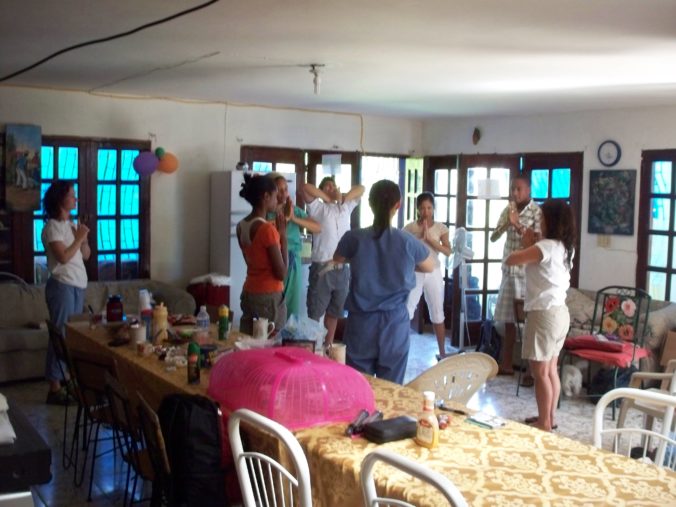
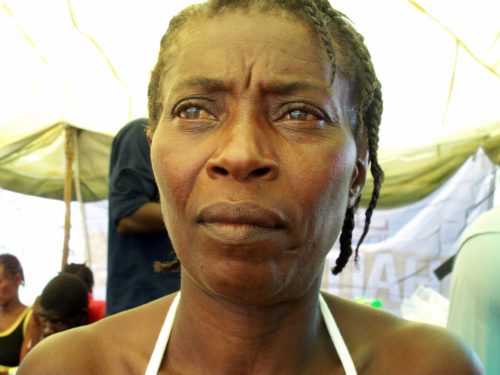
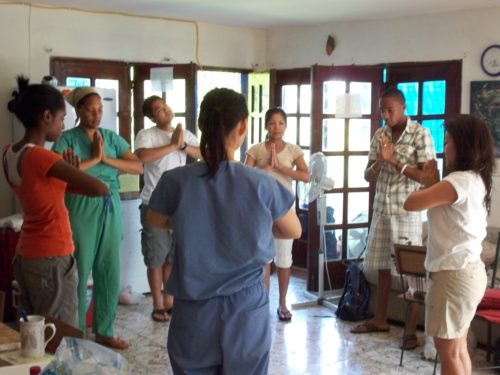
In 1990, I passed up an opportunity to try yoga in post-earthquake Haiti. I was with a Jordan International Aid medical relief team, traveling in and around Port-au-Prince putting on clinics. It was an overwhelming task – every day, far more people were lined up for care than we could possibly see. Women and children were especially hard hit- poor sanitation always hits them harder.

JIA Yoga

JIA medical team doing yoga in Port-au-Prince, Haiti.

Most evenings when we returned to the house where we operated from, some of the medical team would lead a yoga session. Even our Haitian national policemen were joining in, but somehow I just couldn’t bring myself to try it. I can’t claim to know why we sometimes are so resistant to things that we know would be good for us. I do know that it is related to stress and trauma. Shannon has invited me to join one of her classes at a fire station. Somehow, that seems safer than going to a classroom of strangers whose life experiences are unlikely to resemble mine. It seems to be important to start journeys of healing with people who understand, at a level beyond words, where we are coming from.

« Older posts

© 2026 Through the Smoke

Theme by Anders NorenUp ↑